Year-end bookkeeping checklist for rental property owners
By Claire Navarro -
Read a summarized version with:

Year-end bookkeeping for a rental property means closing out the year's rent, deposits and expenses so every figure on your tax return traces back to a record. Done in December, it turns tax season into a review of numbers you already trust, and it shows how each property really did over the year.
This checklist covers the ten jobs most owners work through before December 31 and in the first weeks of January, a worked example for an invented duplex, the dates to plan around and the mistakes that cost the most time. It is general information and is not legal or tax advice. Tax rules change, so check the current IRS guidance and talk with your tax professional before you file.
The year-end bookkeeping checklist
Work through it property by property. Each step builds on the one before it.
- Match rent billed to rent received for every unit. List what each tenant owed for the year and what came in. Any gap is either an open balance to follow up or a recording error to fix. The rent ledger template keeps both columns side by side, and the rent ledger vs tenant ledger guide explains which record answers which question.
- Flag rent paid early. January rent that arrives in December needs its own note. The IRS treats advance rent as income in the year you receive it, whatever period it covers (Publication 527). The prepaid rent guide covers how it shows up in the books.
- Review every security deposit. A deposit you expect to return is generally not income. Any part you keep, for damage or unpaid rent, generally becomes income in the year you keep it (Publication 527). List each deposit held, by tenant, as of December 31. The security deposit entry covers how deposits work.
- Reconcile each bank and card account. Compare the account statement balance with your records for each month, so every payment in and out appears once and only once.
- Put every expense in a category and under a property. Use the same categories all year so the totals line up with the expense lines on Schedule E. The chart of accounts guide gives a starting list, and the rental property expense spreadsheet has a column for each.
- Separate repairs from improvements. A repair keeps the property in working order and is generally deducted in the year you pay it. An improvement, such as a new roof or a replacement water heater, generally has to be depreciated over several years. The CapEx guide explains the difference, and the rental property depreciation calculator shows the yearly figure.
- Collect W-9s and prepare 1099s. For payments made in 2026, the reporting threshold for Form 1099-NEC rose from $600 to $2,000 under the 2025 tax law, according to the IRS instructions for Forms 1099-MISC and 1099-NEC. Whether your rentals count as a trade or business affects whether you file at all, so confirm with your tax professional, and ask every contractor for a W-9 before you pay them.
- Gather receipts and mileage. Match each large expense to a receipt or invoice, and total any mileage you logged for trips to the properties.
- Run a profit and loss and a balance sheet for each property. The rental property profit and loss template and the balance sheet template show the year's result and what each property owns and owes on December 31.
- Take a rent roll snapshot as of December 31. Record each unit's tenant, rent, deposit, lease end date and balance. The rent roll template gives the columns, and the rent roll guide explains how to read one.
A worked example: closing out an invented duplex
All the figures here are made up. An owner has a duplex. Unit A rents for $1,450 a month all year. Unit B rents for $1,550 a month and sat empty for one month between tenants.
Rent billed and received:
- Unit A: $1,450 x 12 = $17,400 billed.
- Unit B: $1,550 x 11 = $17,050 billed.
- Total billed: $17,400 + $17,050 = $34,450.
- Rent received for the year: $34,000. The gap is $34,450 - $34,000 = $450, a balance that Unit B's tenant still owes on December 31, and the tenant ledger shows the same $450.
Expenses, by category:
- Mortgage interest: $9,800
- Property tax: $4,200
- Insurance: $1,650
- Repairs: $2,350
- Utilities: $1,100
- Total: $19,100
Rent received less expenses: $34,000 - $19,100 = $14,900 before depreciation.
The owner also paid a plumber $3,200 to replace Unit B's water heater. That is an improvement, so it sits in a separate memo for depreciation and stays out of the $2,350 of repairs. The plumber was paid more than $2,000 during 2026, which puts the plumber on the list to check for a Form 1099-NEC. A handyman paid $1,800 in total falls under the threshold for 2026 payments.
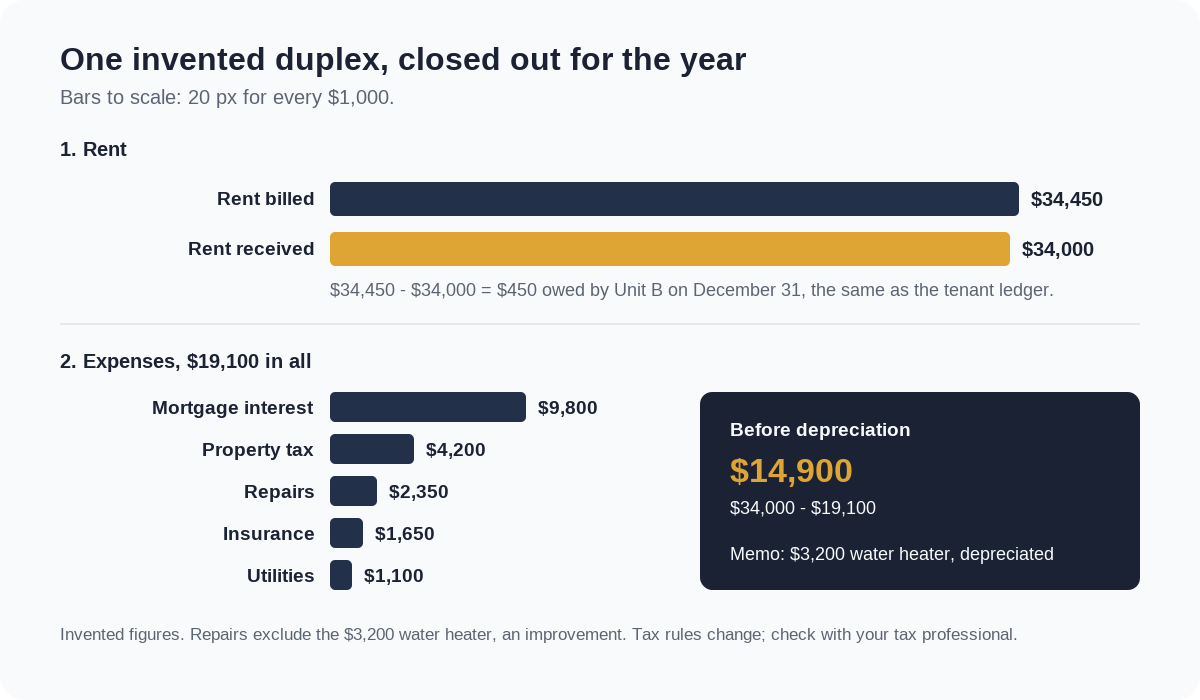
The $450 owed is not income yet for an owner who reports on the cash basis, which most individual owners use: it counts when it is paid. The $3,200 water heater reaches the return through depreciation over several years. Your tax professional works out that figure.
Dates to plan around
- December 31. The year closes. Payments made by this date count in this year's books.
- Late January. Form 1099-NEC is generally due to the IRS and to each contractor by January 31. For payments made in 2026, January 31, 2027 falls on a Sunday, so the IRS deadline moves to Monday, February 1, 2027. Check the IRS instructions for the current year.
- Mid-April. Schedule E goes with your Form 1040. The Schedule E guide covers the lines that matter most for rental owners.
Starting in early December leaves time to chase a missing W-9 or a missing receipt before those dates arrive.
Plan next year while the numbers are fresh
The year-end review is also the best moment to set next year's plan:
- Rents. Compare each unit's rent with rental comps, and if an increase is due, check the notice period before you plan the date. The rent increase notice guide covers how to count it.
- Big repairs. Note anything near the end of its life, such as a roof, a furnace or a water heater, and set money aside for it.
- Leases ending. List every lease renewal coming up in the first half of the year.
- Vacancy. Unit B's empty month cost $1,550. The vacancy rate calculator shows what a month empty does to the year.
Common year-end bookkeeping mistakes
- Mixing personal and rental money. A separate account for each property, or at least for the rentals as a group, makes the reconciliation far shorter.
- Counting a deposit as rent. A deposit held for return stays out of income until you keep part of it.
- Expensing an improvement. A new roof or water heater booked as a repair overstates this year's expenses.
- Waiting for January to ask for W-9s. A contractor who has already been paid has less reason to answer quickly.
- Skipping the rent roll snapshot. It is the record that ties the year's rents to the leases behind them.
Frequently asked questions
What should rental owners do at the end of the year?
Match rent billed to rent received, review every security deposit, reconcile each bank account, put each expense in a category under its property, separate repairs from improvements, collect W-9s and run a profit and loss for each property.
Is rent paid in December for January income this year?
The IRS treats advance rent as income in the year you receive it, whatever period it covers (Publication 527). Check with your tax professional how it applies to you.
Are security deposits income?
A deposit you expect to return is generally not income. Any part you keep, for damage or unpaid rent, generally becomes income in the year you keep it.
Do I need to send 1099s to contractors who worked on my rental?
It depends on whether your rental activity counts as a trade or business and on how much you paid each contractor. For payments made in 2026, the Form 1099-NEC threshold is $2,000. Ask your tax professional.
What is the difference between a repair and an improvement?
A repair keeps the property in working order, such as fixing a leak, and is generally deducted in the year you pay it. An improvement adds value or extends the property's life, such as a new water heater, and is generally depreciated over several years.
Keep every transaction filed under its property
A year-end close is quicker when the year's transactions are already recorded under the right property and category. In KeyRing, you connect your bank accounts securely through Plaid, and each transaction is matched to a property with suggestions you confirm. Income and expense records use categories you can edit, and you can export your transactions to Excel. See what KeyRing does or how plans are priced. For the IRS rules on rental income and expenses, see Publication 527.
Free calculators and templates
- Rental property depreciation calculatorYearly and first-year depreciation over 27.5 or 39 years.
- Rental property tax calculatorNet rental income for the year, the tax on it and what depreciation saves.
Browse all rental property calculators and free templates.