Renting to tenants with bad credit: how property owners weigh the risk
By Maya Ellison -
Read a summarized version with:

Renting to a tenant with bad credit can work well when you look at why the credit is poor, whether the income covers the rent and how the applicant has paid past rent, and then apply the same written standard you use for everyone. A co-signer, a guarantor or a larger deposit where the law allows can cover the gap that a low score leaves. In the invented example below, an applicant with old medical collections earns $4,800 a month for a $1,500 rent, a ratio of 31.25%, and qualifies with a co-signer.
This guide covers what bad credit means for a rental, the fair housing and consumer report rules that frame the decision, what to look at beyond the score, ways to reduce the risk, a worked example and how to keep the decision on the record. It is general information and is not legal or tax advice. Rules vary by state and city. Check your local law or an attorney.
Should you rent to a tenant with bad credit?
Often, yes, as long as the rest of the application holds up. A credit report shows how a person has handled debt. It can be pulled down by things that say little about paying rent, such as a medical bill, a job loss or a divorce, and it can miss things that matter a great deal, such as two years of rent paid on time.
The useful question is narrower: will this applicant pay this rent, on time, for the length of the lease? A low score is one input to that question. Income, rental history and the reasons behind the score are the others, and together they usually tell you more than the score alone.
What counts as bad credit for a rental?
There is no single cutoff. Each owner decides what credit standard to use for a unit, and many set a minimum score with exceptions for applicants who meet other conditions. What matters most is that the standard is written down before you take applications and applied the same way to every applicant for the same unit.
When you review a report with the applicant's written permission, a few items usually carry the most weight:
- Unpaid rent or a balance owed to a previous owner. This is the item closest to the question you are asking.
- Recent late payments, especially on regular bills such as a car loan or a phone plan.
- Collections, and whether they are old, paid or tied to a one-time event such as a medical bill.
- A thin file. Someone young or new to the country may have little credit history at all, which is different from a history of missed payments.
Fair housing and consumer report rules come first
Fair housing laws bar decisions based on protected characteristics such as race, religion, national origin, sex, disability and family status, and many states and cities add more. A credit standard is allowed, but it has to be applied evenly. Write it down, use it for every applicant and keep notes of how each decision was made.
Some states and cities go further. They may limit how far back you can look, how credit history can be used, or require you to count rental assistance and housing vouchers as income. Check the rules where the property is before you set your standard.
If you turn an applicant down, or ask for a co-signer or a larger deposit, because of something in a consumer report, federal law generally requires an adverse action notice. It names the company that supplied the report and tells the applicant about their right to a free copy and to dispute errors. Keep a copy of every notice you send.
What to look at beyond the score
- The reason. Ask the applicant to explain the low score. A medical debt from two years ago, followed by on-time payments, reads very differently from a string of recent missed payments.
- Income against the rent. Many owners look for gross income of about 3 times the rent, a rent-to-income ratio of about 33%. The rent to income ratio calculator works out the ratio and the income a rent needs at your target.
- Rental history. Past rent paid on time is the strongest sign of future rent paid on time. With the applicant's permission, a rental verification from a previous owner or manager confirms the dates, the rent and how it was paid.
- Stability. How long the applicant has held their job or income source, and whether they have savings that could cover a hard month.
- The whole household. If your standard combines income for everyone on the lease, apply it the same way each time. The guide to split rent payments covers how shared households pay.
Ways to reduce the risk
When an applicant falls short on credit but meets your other standards, a few common terms can close the gap. Put the options in your written standard so every applicant in the same position is offered the same ones.
- A co-signer. A co-signer signs the lease and shares responsibility for the rent. Many owners ask a co-signer to meet the same income and credit standard as a tenant, or a higher one.
- A guarantor. A guarantor promises to pay if the tenant does not, usually without living in the unit.
- A larger security deposit. Many states and some cities cap the security deposit, so check the cap before you ask for more than your usual amount.
- Rent paid in advance. Some owners accept prepaid rent where the law allows. The guide to whether prepaid rent is an asset covers how to record it.
- A shorter first term. A month-to-month lease or a short first lease lets both sides see how the tenancy goes before a longer commitment.
- Clear payment terms. A due date, a grace period and a late fee stated in the lease, plus an easy way to pay such as an ACH payment, make on-time rent simpler. The late fee calculator shows what your lease's fee comes to.
A worked example: an applicant with old medical collections
All the figures here are made up. An owner lists a one-bedroom apartment at $1,500 a month. The owner's written standard asks for gross income of at least 3 times the rent, a verified rental history and a minimum credit score. Applicants below the score who meet the other two conditions may qualify with a co-signer who meets the same income standard, or with a deposit of one and a half months of rent, where the local cap allows. The usual deposit is one month.
The applicant earns $4,800 a month before taxes, $57,600 a year. The credit report shows a medical bill in collections from two years ago and on-time payments since then. A rental verification confirms two years of rent paid on time at the applicant's current home.
Using the site's rent to income ratio calculator:
- Rent-to-income ratio: $1,500 / $4,800 = 0.3125, or 31.25%
- Income multiple: $4,800 / $1,500 = 3.2 times the rent
- Income needed at 3 times the rent: 3 x $1,500 = $4,500 a month, or $54,000 a year
The applicant meets the income and rental history conditions and falls below the score, so the owner offers the two options in the written standard, and sends an adverse action notice because the offer is based on the credit report:
- With a co-signer: the usual deposit of one month, $1,500. The co-signer's income has to be at least $4,500 a month.
- Without a co-signer: a deposit of one and a half months, 1.5 x $1,500 = $2,250, which is $750 more than the usual deposit.
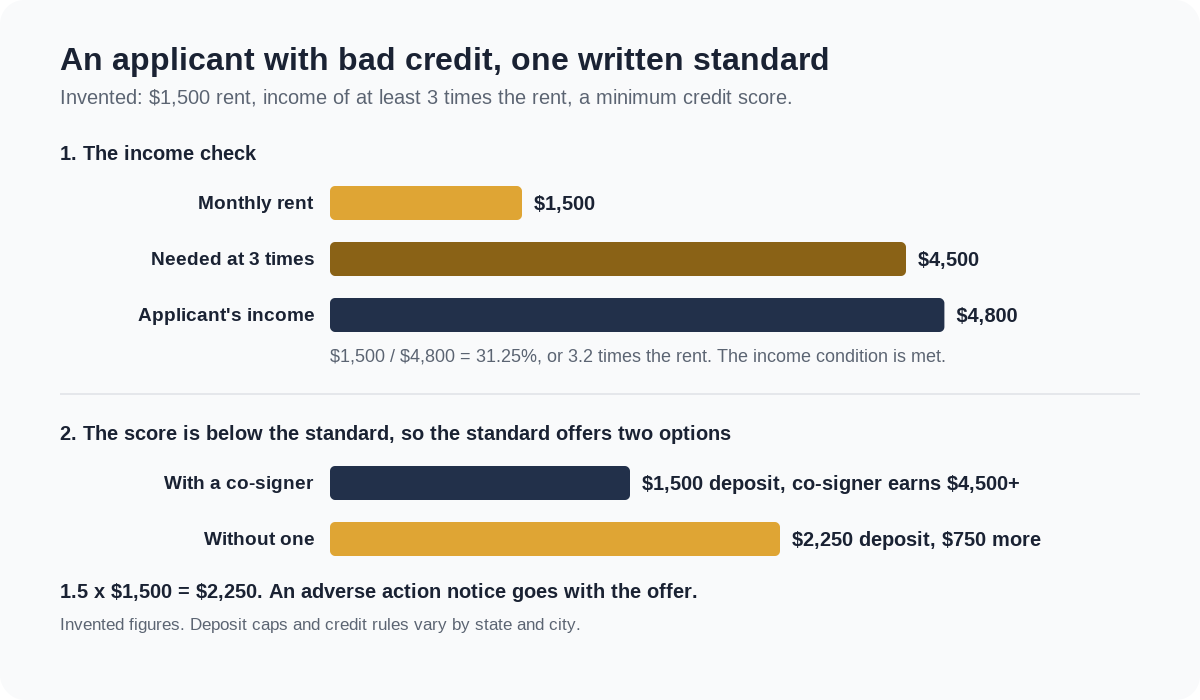
The applicant chooses the co-signer. The owner records the decision, the notice and the co-signer's application with the lease.
Keep the decision on the record
- Write the standard first. Income, rental history, credit and the options for applicants who fall short, all set before you list the unit.
- Apply it to every applicant for the same unit, in the order the applications arrive.
- Keep each application and your notes on why it was approved, approved with conditions or declined.
- Keep copies of adverse action notices and the permission each applicant gave for a credit check.
- Keep the deposit and any prepaid rent on the ledger. A rent ledger that shows each charge and payment from the first month makes any later question simpler to answer.
Frequently asked questions
Can you rent to someone with bad credit?
Yes. Many owners do, when the income covers the rent, the rental history is good and the reason for the low score is clear. Apply the same written standard to every applicant, and check the fair housing and consumer report rules where the property is.
What credit score do you need to rent an apartment?
There is no single required score. Each owner sets a standard for the unit, and many accept a lower score with a co-signer, a guarantor or a larger deposit where the law allows. Rules vary by state and city.
Can an owner ask for a bigger deposit because of bad credit?
Often, if the larger amount stays under any local cap and the same rule applies to every applicant with the same credit result. If the request is based on a consumer report, federal law generally requires an adverse action notice.
Is a co-signer or a guarantor better for an applicant with bad credit?
Both add a second person who is responsible for the rent. A co-signer signs the lease with the tenant, and a guarantor promises to pay if the tenant does not. Many owners ask either one to meet the same income standard as a tenant, or a higher one.
What income should a tenant have for the rent?
Many owners look for gross income of about 3 times the rent. In the invented example, $4,800 a month against $1,500 of rent is 3.2 times the rent, a ratio of 31.25%, above the $4,500 the 3 times rule needs.
Keep applicants and leases in one place
The decision is easier to explain when the records sit together. KeyRing tracks prospective tenants by property, emails them your application form and keeps the completed application with their record. Once the lease starts, each lease keeps its rent charges, payments and balance, you can record cash and check payments, including partial ones, and overdue invoices are flagged automatically. See what KeyRing does or how plans are priced.
Free calculators and templates
- Rent to income ratio calculatorRent as a share of gross income, and the income needed at your target.
- Late fee calculatorA rent late fee as a flat amount or a percentage, with a grace period.
Browse all rental property calculators and free templates.