What is rental verification? Confirming rental history

Rental verification is the step of confirming a rental applicant's history with a previous owner or property manager. The owner who is considering the applicant sends a short form, often called a verification of rent, and the past owner answers factual questions from their records: when the tenancy started and ended, the monthly rent, whether rent was paid on time, whether proper notice was given and whether they would rent to the person again. A 12-month rent ledger with $1,500 due each month that shows $18,000 of rent paid, 10 payments on time and 2 late answers most of that form in a few minutes.
This page covers what rental verification is, what a verification of rent usually asks, a worked example from a rent ledger, how to answer a request about your own tenant, what to share and what to keep private, how to ask about an applicant in a consistent way and the mistakes that cause trouble. It is general information and is not legal or tax advice. Rules vary by state and city. Check your local law or an attorney.
What is rental verification?
Rental verification works in two directions, and most owners end up on both sides of it.
- Asking. When someone applies to rent from you, you contact the owner or manager of the place they live now, or lived before, to confirm what the application says about their tenancy.
- Answering. When your current or former tenant applies somewhere else, the next owner may contact you with the same questions about them.
The request usually arrives as a one-page form by email, fax or mail, sometimes as a phone call. It asks for facts that come straight from the lease and the payment records. A careful answer sticks to those facts, and a careful request asks only for facts that matter to the tenancy.
Rental verification is narrower than a full application review. It confirms one part of an applicant's story, the rental history, from the person who kept the records. Owners who take a co-signer or a guarantor often verify that person's details separately, and the guarantor guide explains how a guarantor's promise works.
What a verification of rent usually asks
Forms differ, but most cover the same short list:
- Tenancy dates. When the lease started and when the tenant moved out, or that they still live there.
- Monthly rent. The rent amount on the lease, and any change during the tenancy.
- Payment history. How many payments arrived on time and how many were late over a period, often the last 12 months.
- Balance. Whether the tenant owes anything today, or owed anything at move-out.
- Notice. Whether the tenant gave the written notice the lease required before moving.
- Lease compliance. Whether the owner issued any written notices of a lease violation. The lease violation notice guide covers what those notices are.
- Would you rent to them again? A yes or no question that many forms include. Some owners answer it, and some decline and point to the factual answers above.
Every one of these questions except the last can be answered from documents: the lease, the tenant ledger and copies of any notices. The last one is an opinion, and owners handle it with care for that reason.
A worked example: a 12-month rent ledger
All the figures here are made up. A property owner rents a single-family house to a tenant at $1,500 a month, due on the first. The lease gives a 5-day grace period and sets a late fee of 5 percent of the rent once the grace period has passed. The tenant applies for a new home, and the next owner sends a verification of rent asking about the last 12 months.
The owner opens the tenant's ledger. The rent ledger vs tenant ledger guide explains the difference between the two records; for one tenant's history, the tenant ledger is the one to read.
| Month | Rent due | Rent paid | Days late | Late fee |
|---|---|---|---|---|
| 1 to 3 | $1,500 each | $1,500 each | 0 | $0 |
| 4 | $1,500 | $1,500 | 8 | $75 |
| 5 to 8 | $1,500 each | $1,500 each | 0 | $0 |
| 9 | $1,500 | $1,500 | 11 | $75 |
| 10 to 12 | $1,500 each | $1,500 each | 0 | $0 |
Counting it up:
- Rent paid: 12 x $1,500 = $18,000
- On-time payments: 12 minus 2 = 10, which is 10 / 12 = 83.33 percent
- Late payments: 2, paid 8 and 11 days after the due date
- Late fee on each: $1,500 x 5 percent = $75, since both payments came after the 5-day grace period
- Late fees paid: 2 x $75 = $150
- Total received: $18,000 + $150 = $18,150
- Balance owed today: $0
The late fee calculator gives the same $75 for each late month. Enter $1,500 of rent, a 5 percent fee, a 5-day grace period, no daily fee and 8 days late, then 11 days late, and both return $75.00. A payment 3 days late would have fallen inside the grace period and carried no fee.
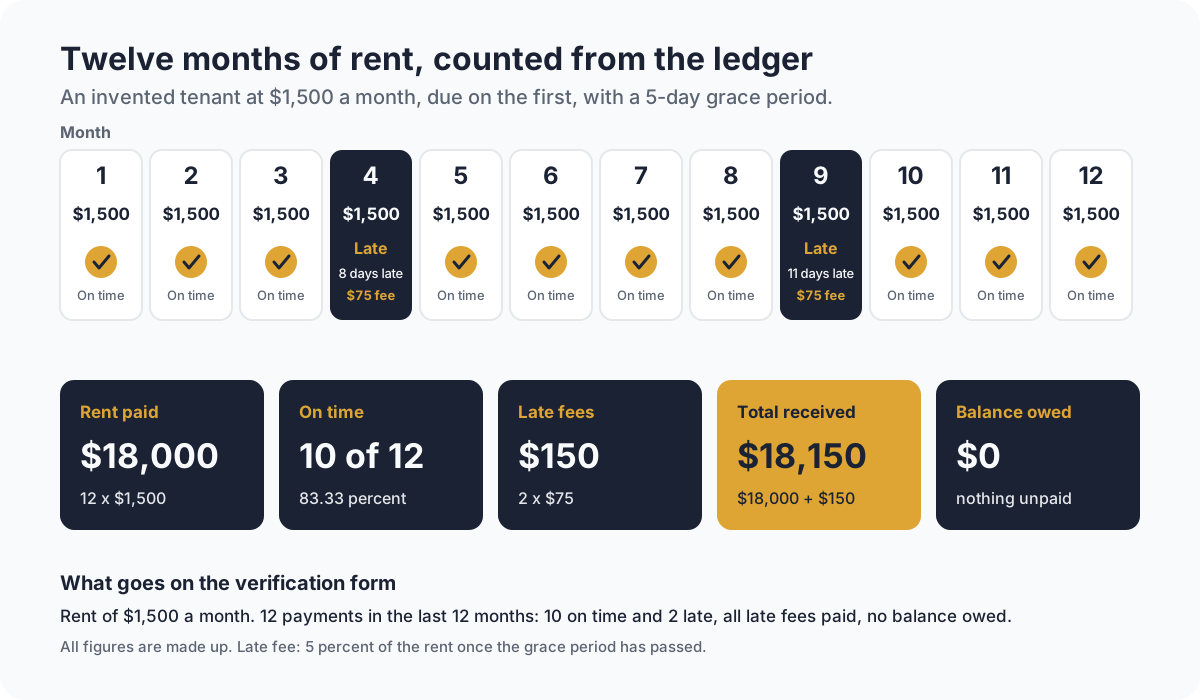
With those counts, the owner's answers on the form are short and backed by records: tenancy dates from the lease, rent of $1,500 a month, 12 payments in the last 12 months, 10 on time and 2 late, all late fees paid, no balance owed. If the form asks about notice, the owner answers from the tenant's written notice once it arrives.
A monthly rent statement for each tenant, or a rent receipt for each payment, keeps those records ready.
Answering a request about your own tenant
A request about your tenant asks you to share personal information about them, so a few habits protect everyone.
- Get written permission first. Many application forms include a signed authorization from the applicant allowing past owners to share their rental history. Ask the requesting owner for a copy before you answer. If none comes, contact your tenant and ask whether they want you to respond.
- Confirm who is asking. Check that the request comes from a real owner or management company. Look up their contact details yourself and call back when anything about the request seems unusual.
- Answer from your records. Give dates, amounts and counts you can show on paper. If the ledger says 10 of 12 payments were on time, say that.
- Skip what you cannot back up. Leave out guesses, impressions and anything you heard secondhand. A plain "I have no record of that" is a complete answer.
- Keep private details private. The other owner needs the rental facts. They have no need for the tenant's bank details, health, family matters or anything unrelated to the tenancy.
- Keep a copy. File the request, the authorization and your answers with the tenant's records.
Some owners decide to confirm only dates and rent amount for every request. That is a choice an owner can make, and it works best when it is applied to every tenant the same way.
Asking for a verification about an applicant
When you are the owner reviewing an application, the same care applies from the other side.
- Get the applicant's written authorization on your application form before you contact anyone.
- Use the same form and the same steps for every applicant. Fair housing laws prohibit treating applicants differently because of protected characteristics, and some states and cities add protections of their own. A written process that you follow every time, in the same order, helps you show that each applicant was treated alike.
- Decide in advance what counts. Write down which answers matter to you, such as a balance owed at move-out or a run of late payments, before you read anyone's answers.
- Ask for facts. Dates, rent, payment counts and notice are useful. Questions about the tenant's personal life are outside the scope of a rental verification.
- Keep the records. File each verification with the application, whatever you decide.
A first-time renter, a student or someone coming from a home they owned may have no rental history to verify. Some owners then ask for other evidence of paying on time, or offer the option of a co-signer or a guarantor. Whatever you choose, apply it the same way to every applicant in the same position.
Common mistakes
- Answering without permission. Sharing a tenant's history before seeing their written authorization exposes you and them.
- Answering from memory. A recollection that "they were always late" may be wrong. Count the ledger before you answer.
- Adding opinions. Comments about personality or lifestyle add risk and help nobody. Stay with dates, amounts and counts.
- Trusting any phone number. An applicant could list a friend as a past owner. Find the owner's contact details yourself, from a public listing or a company website, and compare them with what the applicant gave you.
- Keeping thin records. Without a clear ledger, every request turns into a search through bank statements. Record each payment against the right lease as it arrives.
Frequently asked questions
What is a verification of rent?
It is a short form an owner or property manager fills out to confirm a tenant's rental history for another owner. It usually covers the tenancy dates, the monthly rent, how many payments were on time or late, any balance owed and whether proper notice was given.
Do I have to answer a rental verification request?
Whether you must, and what you may say, depends on where the property is and on what you and the tenant have signed. Many owners choose to answer, and when they do they get the tenant's written permission first and share only facts they can back with records. Rules vary by state and city, so check your local law or an attorney if you are unsure.
What should I say about a tenant who paid late?
Say what the ledger shows. In the worked example, the answer is 12 payments of $1,500 over 12 months, 10 on time and 2 late, all late fees paid and no balance owed. Leave out any description of the tenant beyond those facts.
Can I verify the rental history of someone who rented from a family member?
You can ask, using the same form and steps you use for everyone. Owners often also ask for evidence such as rent receipts or bank records that show the payments. Keep whatever you decide consistent across applicants.
How long should I keep rent payment records?
Keep them at least as long as you would need them to answer a verification or a dispute, and as long as tax rules require. A tax professional or attorney can tell you the right period for your situation.
Keep a clear payment history for every lease
A rental verification is easy to answer when every payment is already on the right lease. In KeyRing, each lease keeps its rent charges, payments and balance, you can record cash and check payments, including partial ones, and overdue invoices are flagged automatically. Each month's rent invoices are drafted for you to approve before they are sent, and each tenant gets a PDF invoice by email. See what KeyRing does or how plans are priced.
Free calculators and templates
- Late fee calculatorA rent late fee as a flat amount or a percentage, with a grace period.
- Rent statement templateA tenant's charges, payments and balance for a period, from the opening balance to what is due now.
- Rent receipt templateA printable rent receipt, two to a page, and a CSV log for every payment you receive.
Browse all rental property calculators, free templates and the glossary.
From the blog
- Rent ledger vs tenant ledger: what to track and whyA lease ledger, or tenant ledger, records one lease's charges, payments and balance. A rent ledger can cover a whole property. See both with worked examples.
- What is a guarantor? Guarantor vs co-signer on a leaseA guarantor promises to pay the rent if the tenant does not. How a guarantor differs from a co-signer, who usually qualifies and what a guaranty covers.
- What is a rent roll (with a free template)A rent roll lists each unit, tenant, lease and rent in a property as of one date. See what it includes, a fourplex example and the numbers you can pull from it.