What is a mortgage note? Promissory notes and seller financing

A mortgage note is the signed promise to repay a loan used to buy real estate. It sets the amount borrowed, the interest rate, the term, the monthly payment and what happens if a payment is late or missed. A separate document, the mortgage or deed of trust, pledges the property as security for that promise. In the example on this page, a seller who carries a $225,000 note at 8 percent on the sale of a rental receives $1,650.97 a month.
This page covers what a mortgage note is, how it differs from the mortgage itself, who holds each document, how notes are sold and transferred, seller financing when you sell a rental, buying notes as an investment and a worked example run through the site's loan payment math. It is general information and is not legal or tax advice. Rules vary by state and city. Check your local law or an attorney.
What is a mortgage note?
A mortgage note, also called a promissory note or real estate note, is the borrower's written promise to pay back a loan on stated terms. The property itself is pledged in a second document.
A typical note sets out:
- The amount borrowed.
- The interest rate, fixed or adjustable.
- The term, and whether a balloon payment comes due early.
- The payment: the amount, due date and where to send it.
- Late terms: the grace period, the late fee and when the loan is in default.
- Prepayment rights and any fee for paying early.
- Default and acceleration: what the holder can do after a default, such as calling the whole balance due.
Most notes on rental property loans are fully amortizing or amortize over a long schedule. Each payment covers that month's interest first, and the rest reduces the balance. The amortization guide shows how that split changes over the life of a loan.
The note and the mortgage are two documents
People say "mortgage" for the whole loan, but at closing a borrower usually signs two documents:
| Promissory note | Mortgage or deed of trust | |
|---|---|---|
| What it does | Promises to repay the debt | Pledges the property as security for the debt |
| Who signs | The borrower | The owner of the property, usually the borrower |
| Who holds it | The lender, or whoever buys the note | Recorded in the county land records, with the lender named |
| Where it goes | Kept by the holder, often in a vault or a file | Public record |
| What it allows | A claim for the money owed | Foreclosure on the property after a default |
The mortgage and the deed of trust do the same job in different ways. A mortgage is between two parties, the borrower and the lender. A deed of trust adds a third party, a trustee, who holds a form of title until the loan is paid. Which one is used, and how foreclosure works under each, depends on local law. A local real estate attorney can tell you which applies to a property.
The borrower keeps title to the property. When the loan is paid off, the lender releases the mortgage or deed of trust, and the release is recorded.
Who holds the note, and how notes change hands
The original lender is the first holder of the note. Notes are commonly sold after closing, and a loan can pass through several holders over its life. A note is transferred by endorsement, the way a check is signed over, or by a separate page attached to it. The mortgage or deed of trust is assigned to the new holder, and the assignment is usually recorded.
For the borrower, the terms stay the same: the same balance, rate and payment. What changes is who receives the payment. A loan servicer often collects on behalf of the holder, and the borrower is told in writing where to send payments after a transfer.
Seller financing: when the seller holds the note
When you sell a rental, the buyer usually pays you in full with a bank loan. In a seller-financed sale, you lend part of the price yourself. The buyer pays a down payment, signs a promissory note to you for the rest and gives you a mortgage or deed of trust on the property. You become the lender and the note holder, and the buyer becomes the owner.
Why owners consider it:
- A wider pool of buyers. Some buyers cannot or prefer not to borrow from a bank.
- Monthly income. The seller receives principal and interest each month.
What to weigh:
- Default risk. If the buyer stops paying, the seller's remedy is usually foreclosure, which takes time and money and may return a property in worse condition.
- Your own mortgage. If you still owe on the property, your loan may have a due-on-sale clause. Ask your lender and an attorney before you sell on terms.
- Lending rules. Federal and local rules can apply to seller financing, especially when the buyer will live in the home. An attorney can tell you which apply to your sale.
- Taxes. A sale paid over time may be reported as an installment sale, which can spread part of the gain over the years you are paid. Some parts of the gain, such as depreciation recapture, are generally taxed in the year of sale. IRS Publication 537 covers installment sales. Ask a tax professional before you agree to terms.
- The paperwork. An attorney or title company usually prepares the documents and records the security instrument.
A worked example: a seller-financed rental
All the figures here are made up. An investor sells a single-family rental for $300,000. The buyer pays $75,000 down, and the seller carries the rest on a promissory note at 8 percent. Payments are figured as if the loan ran 30 years, and the remaining balance is due as a balloon payment after 5 years.
- Note amount: $300,000 minus $75,000 = $225,000
- Share of the price financed: $225,000 / $300,000 = 75 percent, the loan to value on the day of the sale
- Monthly payment on $225,000 at 8 percent over 30 years: $1,650.97
- Payments in a year: $1,650.97 x 12 = $19,811.64
The payment uses the standard loan payment formula the site's calculators use, with a monthly rate of 8 / 12 percent and 360 payments.
An amortization snapshot shows how each payment splits between interest and principal:
| Payment | Interest | Principal | Balance after |
|---|---|---|---|
| 1 | $1,500.00 | $150.97 | $224,849.03 |
| 2 | $1,498.99 | $151.98 | $224,697.05 |
| 12 | $1,488.55 | $162.42 | $223,120.43 |
| 60 | $1,427.54 | $223.43 | $213,907.18 |
- First month's interest: $225,000 x 0.08 / 12 = $1,500.00
- First month's principal: $1,650.97 minus $1,500.00 = $150.97
- Year 1: the seller receives $17,932.07 of interest and $1,879.57 of principal, leaving a balance of $225,000 minus $1,879.57 = $223,120.43
- First five years: $87,965.40 of interest and $11,092.82 of principal
- Balloon after 60 payments: $225,000 minus $11,092.82 = $213,907.18
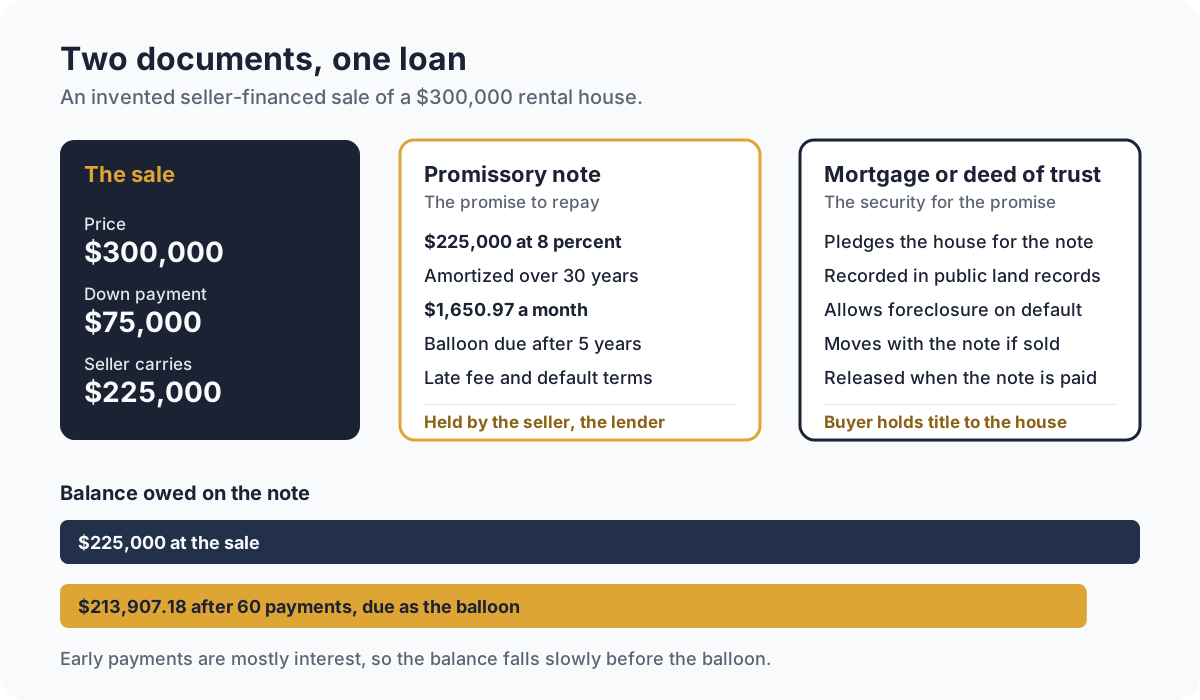
The balloon is the part buyers most need to plan for. Most buyers pay it by refinancing with a bank, so the property's value, the buyer's credit and rates in year 5 all matter.
The buyer's side can be checked the way a bank would. A lender compares the property's income with the loan payments in the debt service coverage ratio, and the DSCR calculator works it out from the rent, expenses and loan terms. The rental property calculator and the rental cash flow calculator show what is left after the note payment, and the loan to value calculator checks the size of the note against the price.
Buying notes as an investment
Some investors buy existing notes from their holders. The buyer of a note pays a lump sum and receives the borrower's remaining payments, and the price is often below the unpaid balance. The return depends on the price paid, the rate and term left on the note and whether the borrower keeps paying.
Notes are often sorted into performing notes, where the borrower pays on time, and nonperforming notes, where payments have stopped and a modification, payoff or foreclosure may follow. Before buying, investors usually check the original note and every endorsement, the recorded security instrument and its assignments, the payment history and the property's value. As with any deal, the cash on cash return guide and the ARV guide cover ways to judge the numbers. Buying and servicing notes can bring licensing and consumer protection rules, so ask an attorney who works with notes what applies.
Common mistakes
- Skipping the attorney on a seller-financed sale. Forms copied from elsewhere may leave out late terms, default terms or local requirements.
- Ignoring the balloon. A short balloon on a long amortization keeps payments low and leaves a large balance due. Plan for how it will be paid.
- Losing track of payments. A holder needs a record of every payment, its interest and principal and the balance after it, for statements, taxes and any later sale of the note.
Frequently asked questions
What is the difference between a mortgage and a mortgage note?
The mortgage note is the promise to repay the loan. The mortgage, or a deed of trust in some places, pledges the property as security for that promise and lets the holder foreclose after a default. A borrower usually signs both at closing.
Who holds the mortgage note?
The lender holds it at first. Notes are often sold, so the holder can change over the life of the loan. In a seller-financed sale, the seller holds the note.
Can a mortgage note be sold?
Yes. A note is usually transferred by endorsement, and the mortgage or deed of trust is assigned to the new holder. The borrower's terms stay the same, and the borrower is told where to send payments.
What happens to the note when the loan is paid off?
The holder marks the note paid and returns it or confirms payment in writing, and a release of the mortgage or deed of trust is recorded. In the example, the buyer pays off the $213,907.18 balance at the balloon.
How is seller financing taxed?
A sale paid over time may be reported as an installment sale, which can spread part of the gain across the years you are paid, and the interest you receive is generally taxable income. Some parts of the gain can be taxed in the year of sale. Ask a tax professional before you agree to terms.
Keep every note payment on the right property
A note holder needs a clear record of each payment received, and a buyer needs one of each payment made. In KeyRing, you connect your bank accounts securely through Plaid, and each transaction is matched to a property with suggestions you confirm. Income and expense records use categories you can edit, and you can export your transactions to Excel. See what KeyRing does or how plans are priced.
Free calculators and templates
- DSCR calculatorHow many times NOI covers the loan payments, and the loan a target ratio allows.
- Rental property calculatorCash flow, cap rate, cash on cash return and ROI for one property, all at once.
- Rental cash flow calculatorMonthly cash flow line by line, per unit, with the break-even rent.
Browse all rental property calculators, free templates and the glossary.
From the blog
- What is ARV? After repair value for BRRRR investorsARV is what a property should be worth once the repairs are done. How to estimate it from comparable sales, and how it sets a BRRRR refinance, with an example.
- What is a cash-on-cash return? A worked example for a small rental portfolioCash-on-cash return is a year of pre-tax cash flow divided by the cash you put in. The formula, and a worked example for three rentals and the portfolio.
- What is cap rate? How to calculate it for a rental propertyCap rate is net operating income divided by a property's price or value. How to calculate it, a worked fourplex example and what it leaves out.