What is amortization? Loan amortization for rental property

Amortization is paying off a loan through regular, equal payments over a set term, so the balance reaches zero with the last payment. Each payment covers the interest owed for that period first, and the rest pays down the principal. On a 30-year rental mortgage of $240,000 at 6.5 percent, the monthly payment is $1,516.96, and the first one is $1,300.00 of interest and $216.96 of principal.
This page covers what amortization means for a loan, the payment formula, a worked schedule for a rental mortgage, how the split between interest and principal shifts over the years, how amortization differs from depreciation, how loan costs on a rental are amortized for tax and the mistakes that throw a schedule off. It is general information and is not legal or tax advice. Tax rules change and depend on your situation, so check with a tax professional. Rules vary by state and city. Check your local law or an attorney.
What is amortization?
An amortizing loan is paid down a little with every payment. The payment stays the same for the life of a fixed-rate loan, but what it pays for changes. Interest is charged on the balance still owed, so it is largest at the start, when the balance is largest. As the balance falls, less of each payment goes to interest and more goes to principal.
The word has a second meaning in accounting and tax: spreading the cost of an intangible asset, such as loan fees, over the years it benefits. Both meanings show up for a real estate investor, and both are covered here.
An amortization schedule is the table that lists every payment on a loan, with its interest, its principal and the balance left after it.
The amortization formula
For a fixed-rate loan with monthly payments:
Payment = P x r / (1 minus (1 + r) to the power of minus n)
- P is the amount borrowed.
- r is the monthly interest rate, the yearly rate divided by 12.
- n is the number of monthly payments, the years times 12.
Each month, the interest is the balance times r, the principal is the payment minus the interest, and the new balance is the old balance minus the principal.
A worked schedule: a $240,000 rental mortgage
All the figures here are made up for this example. A real estate investor borrows $240,000 to buy a single-family rental, at 6.5 percent a year fixed for 30 years.
- Monthly rate: 6.5 percent / 12 = 0.541667 percent, or 0.065 / 12 as a decimal
- Number of payments: 30 x 12 = 360
- Monthly payment, principal and interest: $1,516.96
The first three payments:
| Payment | Interest | Principal | Balance after |
|---|---|---|---|
| 1 | $240,000.00 x 0.065 / 12 = $1,300.00 | $1,516.96 minus $1,300.00 = $216.96 | $239,783.04 |
| 2 | $1,298.82 | $218.14 | $239,564.90 |
| 3 | $1,297.64 | $219.32 | $239,345.58 |
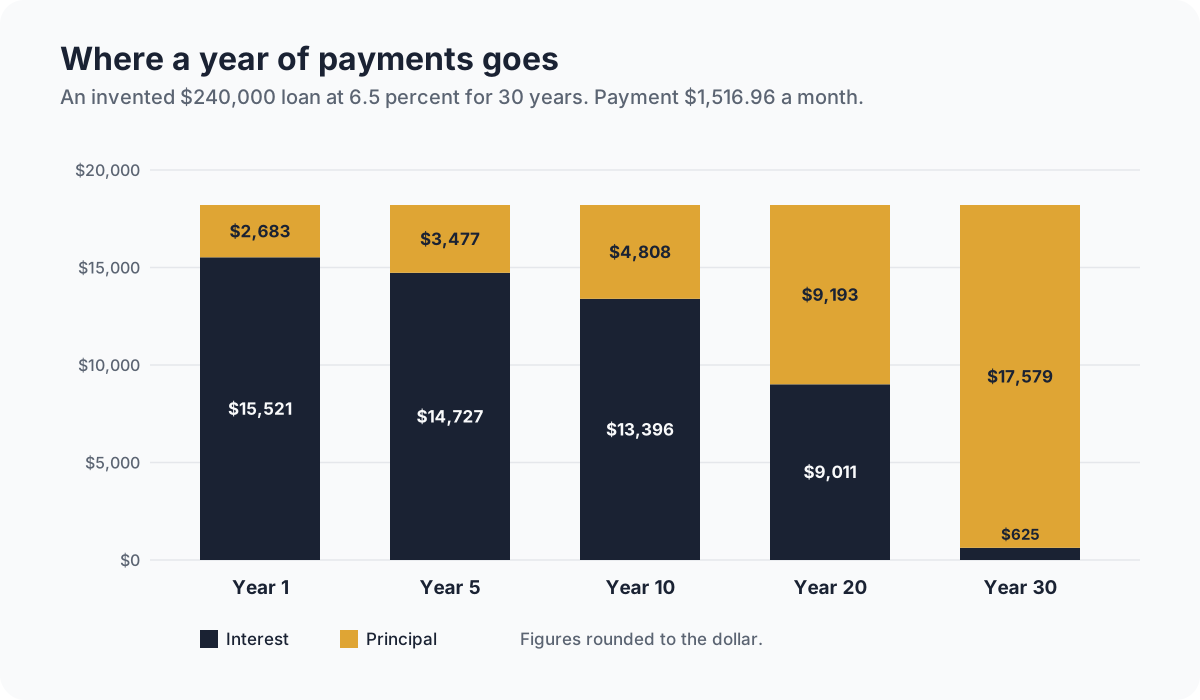
In year one, the 12 payments total 12 x $1,516.96 = $18,203.52. About $15,521 of that is interest and about $2,683 is principal, so the balance at the end of the year is about $237,317.
Over the full 30 years, 360 payments of $1,516.96 come to $546,105.60. Taking away the $240,000 borrowed, about $306,106 of that is interest. In practice the last payment is adjusted by a few cents to bring the balance to exactly zero.
How the split shifts over the years
| Year | Interest paid that year | Principal paid that year | Balance at year end |
|---|---|---|---|
| 1 | about $15,521 | about $2,683 | about $237,317 |
| 5 | about $14,727 | about $3,477 | about $224,666 |
| 10 | about $13,396 | about $4,808 | about $203,463 |
| 20 | about $9,011 | about $9,193 | about $133,597 |
| 30 | about $625 | about $17,579 | $0 |
The yearly figures are rounded to the dollar, so each row adds up to the year's $18,203.52 of payments within a few dollars. The crossover, the first payment where more goes to principal than to interest, is payment 233, early in year 20. After 10 years of payments, the investor still owes about $203,463, about 85 percent of the amount borrowed.
Why amortization matters for a rental
- Cash flow counts the whole payment. The full $1,516.96 leaves your account every month, whatever the split. The rental cash flow calculator subtracts the full payment from the rent.
- Equity builds slowly at first. The principal portion is equity you build each month. It is small in the early years and grows over the loan. The rental property calculator shows the payment and returns for a purchase, and the cash on cash return guide shows how the payment affects your return on the money you put in.
- NOI comes before the mortgage. Net operating income does not include the loan payment at all. The NOI guide explains why, and DSCR compares the two.
- The interest and the principal are taxed differently. Mortgage interest on a rental is generally a deductible expense on Schedule E, while the principal you repay is not an expense. The Schedule E guide shows where the interest goes.
A rental property balance sheet shows the loan balance as a liability. Update it from the lender's statement, or from your schedule, at least once a year, so the equity in each property stays current.
Amortization vs depreciation
Both spread something over time, and both appear on a rental's tax return, so they are easy to mix up.
| Loan amortization | Depreciation | Tax amortization of loan costs | |
|---|---|---|---|
| What it spreads | Repaying the principal of a loan | The cost of the building and improvements | Fees paid to get a loan |
| Over what period | The loan term, by the schedule | A recovery period set by the tax rules | Usually the loan term |
| Is it a deductible expense? | The interest is, the principal is not | Yes, each year | Yes, each year |
Depreciation spreads the cost of the building over its recovery period, and land is never depreciated. The rental property depreciation calculator works out the yearly deduction.
Amortizing loan costs on a rental
Some costs of getting a mortgage on a rental, such as points and certain loan fees, generally cannot be deducted all at once. They are usually amortized over the life of the loan. If the investor in the example paid $3,600 in points on the 30-year loan, the yearly deduction would be $3,600 / 30 = $120, which is $3,600 / 360 = $10 a month. If the loan is paid off or refinanced early, any amount not yet deducted may generally be deducted then. Which costs count, and how, depends on the tax rules and your situation, so confirm with a tax professional.
Other loan shapes
- Interest-only loans charge only interest for a set period, so the balance does not fall. When the interest-only period ends, the payment rises to amortize the balance over the remaining term.
- Balloon loans are amortized as if over a long term but come due sooner, with the remaining balance owed in one large payment.
- Adjustable-rate loans recalculate the payment when the rate changes, using the balance and the months left.
- Shorter terms, such as 15 years, carry a higher payment and build equity faster, with less interest overall.
Common amortization mistakes
- Using the yearly rate as the monthly rate. Divide the yearly rate by 12 for a monthly schedule.
- Counting the whole payment as an expense. Only the interest part of a mortgage payment is an expense. The principal reduces the loan.
- Leaving out escrow. A lender's monthly bill often adds property taxes and insurance on top of principal and interest. Those are separate expenses that sit outside the amortization schedule.
- Rounding too early. Round the payment to the cent, then figure each month's interest from the balance.
- Mixing up amortization and depreciation. One spreads a loan, the other spreads the cost of a building.
Frequently asked questions
What is amortization in simple terms?
Amortization is paying off a loan in equal payments over a set time. Each payment covers that month's interest first, and the rest lowers the balance, so the loan reaches zero with the last payment.
How do you calculate an amortization schedule?
Work out the monthly payment from the amount borrowed, the monthly rate and the number of payments. Then, each month, multiply the balance by the monthly rate for the interest, subtract that from the payment for the principal and subtract the principal from the balance.
Why is most of my early mortgage payment interest?
Interest is charged on the balance you still owe, and the balance is largest at the start. In the example, the first payment of $1,516.96 is $1,300.00 of interest and $216.96 of principal.
What is the difference between amortization and depreciation?
Loan amortization is repaying a loan's principal over its term. Depreciation spreads the cost of a building and its improvements over a recovery period for tax. Rules vary by state and city, and tax rules change. Check your local law or an attorney.
Is mortgage principal deductible on a rental?
Generally no. Mortgage interest on a rental is usually a deductible expense, and the principal you repay is not. The building's cost is recovered through depreciation. Confirm the treatment for your situation with a tax professional.
Keep every payment on the right property
Mortgage payments are easier to follow when every transaction sits with its property. In KeyRing, you connect your bank accounts securely through Plaid, and each transaction is matched to a property with suggestions you confirm. Income and expense records use categories you can edit, and you can export your transactions to Excel for your tax professional. See what KeyRing does or how plans are priced.
Free calculators and templates
- Rental property calculatorCash flow, cap rate, cash on cash return and ROI for one property, all at once.
- Rental cash flow calculatorMonthly cash flow line by line, per unit, with the break-even rent.
- Rental property depreciation calculatorYearly and first-year depreciation over 27.5 or 39 years.
- Rental property balance sheet templateAssets, liabilities and equity for one property at year end, next to last year's.
Browse all rental property calculators, free templates and the glossary.
From the blog
- What is Schedule E? Rental income and expenses, line by lineSchedule E (Form 1040) is the IRS form for rental income and expenses. See who files it, the lines for rent, expenses and depreciation, and when it is due.
- What is a cash-on-cash return? A worked example for a small rental portfolioCash-on-cash return is a year of pre-tax cash flow divided by the cash you put in. The formula, and a worked example for three rentals and the portfolio.
- What is NOI? Net operating income for rental propertyNOI is a rental property's income after vacancy and operating expenses, before the mortgage. What goes in, what stays out, a duplex example and its uses.