What is depreciation recapture? The tax when you sell a rental
Depreciation recapture is the part of the gain on selling a rental property that comes from the depreciation you took, or could have taken, while you owned it. Depreciation lowers your tax each year you hold the property, and it also lowers your basis, so the gain is larger when you sell. For a residential rental building, the federal tax on that part of the gain is generally figured at your ordinary income tax rate, capped at 25 percent, and the rest of the gain is taxed as a long-term capital gain. In the example on this page, a sale with a $150,000 gain includes $70,000 of depreciation recapture, which costs $16,800 in federal tax at a 24 percent rate.
This page covers what depreciation recapture is, how depreciation lowers your basis, a worked example run through the site's calculator, what the 25 percent cap does, how cost segregation and a 1031 exchange change the picture and which records to keep. It is general information and is not legal or tax advice. Rules vary by state and city. Check your local law or an attorney. Ask a tax professional before you sell.
What is depreciation recapture?
When you own a rental property in the United States, you deduct part of the building's cost every year as depreciation. A residential rental building is depreciated over 27.5 years, and the land under it is never depreciated. The rental property depreciation calculator shows the yearly figure, and the Schedule E guide covers where it goes on an individual owner's return.
Each dollar of depreciation also comes off your basis in the property. Basis is, roughly, what you paid plus the improvements you made. When you sell, your gain is the sale price minus selling costs, minus that reduced basis. The lower basis means a larger gain, and the tax rules treat the part of the gain that came from depreciation differently from the rest.
On a residential rental building, the IRS calls that part unrecaptured section 1250 gain. People usually just say depreciation recapture. It is taxed at your ordinary income tax rate, with a federal maximum of 25 percent. The gain above it, for property held more than a year, is a long-term capital gain taxed at the long-term rates. Other kinds of property, such as appliances or carpet depreciated on shorter schedules, follow their own recapture rules, which can tax the recaptured amount at ordinary income rates with no 25 percent cap.
Put simply: depreciation saved you tax while you held the property, and recapture takes back part of that saving when you sell.
Allowed or allowable: depreciation you skipped still counts
The tax rules reduce your basis by the depreciation you were allowed to take, whether or not you actually claimed it. This is often described as "allowed or allowable." An owner who never claimed depreciation can still face recapture on the depreciation they could have claimed, with none of the yearly deductions to show for it.
If you find that you missed depreciation in earlier years, a tax professional can tell you whether you can still claim it, for example through amended returns or a change in accounting method, before you sell.
A worked example: selling a single-family rental
All the figures here are made up, and they run through the site's depreciation recapture calculator. A real estate investor bought a single-family rental for $350,000, including the purchase costs that add to basis. Of that, $75,000 was the land, leaving a building basis of $275,000, which is about $275,000 / 27.5 = $10,000 of depreciation a year. Later the owner put on a $20,000 roof. By the time of the sale, the owner has taken $70,000 of depreciation on the building and the roof together.
The owner sells for $480,000 and pays $30,000 in selling costs. The owner's invented ordinary income tax rate is 24 percent and the invented long-term capital gains rate is 15 percent.
- Adjusted basis: $350,000 + $20,000 minus $70,000 = $300,000
- Amount realized: $480,000 minus $30,000 = $450,000
- Total gain: $450,000 minus $300,000 = $150,000
- Depreciation recapture: the gain up to the $70,000 of depreciation = $70,000
- Tax on the recapture: $70,000 x 0.24 = $16,800
- Long-term capital gain: $150,000 minus $70,000 = $80,000
- Tax on the capital gain: $80,000 x 0.15 = $12,000
- Estimated federal tax: $16,800 + $12,000 = $28,800
Without the depreciation, the basis would have been $370,000 and the gain $80,000. The $70,000 of depreciation adds $70,000 to the gain, and that slice is the part taxed at the recapture rate.
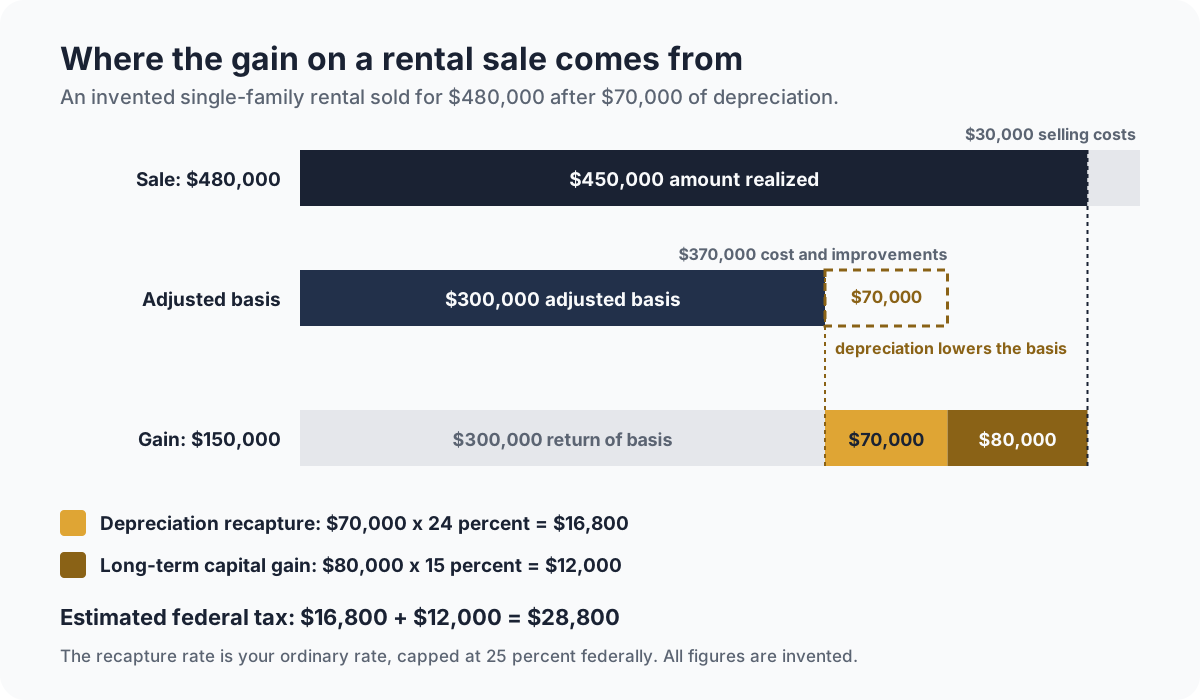
The deductions and the recapture roughly balance in this case. The $70,000 of depreciation saved about $70,000 x 0.24 = $16,800 of tax over the years, at the same invented 24 percent rate, and the sale takes back the same $16,800. The owner still had the use of that money for years, and the outcome changes when your tax rate during ownership differs from your rate in the year you sell.
What the 25 percent cap does
The cap matters for owners in higher brackets. If the same owner's ordinary income tax rate were an invented 32 percent, the recapture would be taxed at the 25 percent cap:
| Ordinary rate | Rate on the recapture | Tax on $70,000 of recapture | Estimated federal tax on the sale |
|---|---|---|---|
| 24 percent | 24 percent | $16,800 | $28,800 |
| 32 percent | 25 percent | $17,500 | $29,500 |
In both rows the $80,000 capital gain is taxed at the same invented 15 percent, $12,000. The recapture rate is the lower of your ordinary rate and 25 percent, so an owner in a lower bracket pays less than 25 percent on it.
These estimates are federal income tax only. A state income tax can apply to the whole gain, and above certain incomes the 3.8 percent net investment income tax can apply too. The capital gains tax calculator adds both to the same kind of sale.
Cost segregation and recapture
A cost segregation study moves part of a building's cost onto shorter schedules, so more depreciation comes in the early years. That raises the depreciation you take before a sale, and so the amount subject to recapture. Gain on the reclassified parts, such as appliances and carpet, generally falls under the rules for that kind of property and can be taxed at ordinary income rates. The cost segregation calculator shows the early deductions, and a tax professional can estimate the recapture side before you order a study or plan a sale.
Deferring recapture with a 1031 exchange
A 1031 exchange lets you sell one investment property and buy another of like kind under strict rules and deadlines, and defer the tax on the gain. In a full exchange, the deferred gain, including the part that came from depreciation, carries into the replacement property through a lower basis. The recapture is put off until a later taxable sale.
Cash or debt relief you receive in the exchange, called boot, is generally taxed in the year of the exchange, up to the gain. The 1031 exchange calculator estimates the boot and the deferred gain. Plan an exchange with a qualified intermediary and a tax professional before you list the property.
Records to keep
Recapture is figured from numbers that build up over many years, so the records matter most at the end:
- The closing statement from the purchase, showing the price and the costs that add to basis.
- How the price was split between land and building, and the reasoning.
- Every improvement, with invoices and the date each was placed in service.
- Each year's depreciation, from your returns and depreciation schedules, including any cost segregation report.
- The closing statement from the sale, showing the price and the selling costs.
- Any 1031 exchange paperwork, which carries the basis into the next property.
A chart of accounts for rental property helps keep improvements apart from repairs, which matters because improvements add to basis and are depreciated, while repairs are deducted in the year you pay them.
Frequently asked questions
What is depreciation recapture in simple terms?
It is the part of the gain on selling a rental that came from depreciation. Depreciation lowered your tax while you owned the property, and when you sell, that part of the gain is taxed at your ordinary rate, up to 25 percent federally for a residential rental building.
How much is depreciation recapture tax?
It depends on how much depreciation you took or could have taken, your gain and your ordinary rate. In the example, $70,000 of recapture taxed at an invented 24 percent rate is $16,800. Run your own numbers in the depreciation recapture calculator and check them with a tax professional.
Do I owe recapture if I never claimed depreciation?
Generally yes. Your basis is reduced by the depreciation that was allowable, whether or not you claimed it. Ask a tax professional whether you can still claim missed depreciation before you sell.
Can a 1031 exchange avoid depreciation recapture?
A 1031 exchange can defer the tax, including the recapture, by carrying the gain into the replacement property. The tax can come due on a later taxable sale, and boot received in the exchange is generally taxed in the year of the exchange.
What if I sell a rental at a loss?
If the sale price minus selling costs is below your adjusted basis, there is no gain, so there is no recapture to tax. A loss on a rental has its own rules, so ask a tax professional how it applies to your return.
Keep the records a sale and a tax return need
Recapture is figured from records that span the years you own a property. In KeyRing, you connect your bank accounts securely through Plaid, and each transaction is matched to a property with suggestions you confirm. Income and expense records use categories you can edit, and you can export your transactions to Excel for your tax professional. See what KeyRing does or how plans are priced.
Free calculators and templates
- Depreciation recapture calculatorThe tax on the depreciation part of a rental sale, and the capital gain on the rest.
- Rental property depreciation calculatorYearly and first-year depreciation over 27.5 or 39 years.
- Capital gains tax on rental property calculatorThe gain on selling a rental, the tax on it and the cash you keep.
- 1031 exchange calculatorThe gain a 1031 exchange defers, the boot taxed now and the new property's basis.
- Rental property balance sheet templateAssets, liabilities and equity for one property at year end, next to last year's.
Browse all rental property calculators, free templates and the glossary.
From the blog
- What is Schedule E? Rental income and expenses, line by lineSchedule E (Form 1040) is the IRS form for rental income and expenses. See who files it, the lines for rent, expenses and depreciation, and when it is due.
- Chart of accounts for rental property (with a free template)What a chart of accounts is, how to set one up for rental property with Schedule E in mind, a worked duplex example and a free CSV template.