What is ARV? After repair value for BRRRR investors
By Claire Navarro -

ARV, short for after repair value, is what a property should be worth once the planned repairs and upgrades are done. A house bought for $140,000 that needs $36,000 of work might have an ARV of $240,000 if similar renovated homes nearby have sold for about that. For BRRRR investors (buy, rehab, rent, refinance, repeat), ARV sets the size of the refinance loan, and with it how much of your cash comes back.
This guide covers what ARV is, how to estimate it from comparable sales, a worked example for an invented house, how ARV drives a BRRRR refinance, what happens when the appraisal comes in low, and the mistakes that throw an estimate off. It is general information and is not financial or tax advice. Loan terms are set by your lender, so ask your lender, and ask your tax professional about how repair costs are treated on your return.
What is ARV?
ARV is an estimate of a property's market value after the work you plan to do. It is a forecast: the house does not exist in that condition yet, so no one can look up its value. You build the estimate from recent sales of similar homes nearby that are already in the condition yours will be in.
| Value | What it means | Who sets it |
|---|---|---|
| Purchase price | What you pay for the property as it is | You and the seller |
| As-is value | What the property is worth today, before any work | The market, or an appraiser |
| After repair value (ARV) | What it should be worth once the planned work is done | Your estimate, from comparable sales |
| Appraised value | What the lender's appraiser says it is worth on the day | The appraiser the lender uses |
The difference that matters most is between ARV and appraised value. Your ARV is a planning figure. At the refinance, the lender lends against its own appraisal, and that figure decides the loan.
How to estimate ARV from comparable sales
- Define the finished property. Write down what it will be after the work: bedrooms, bathrooms, square footage, kitchen and finishes.
- Find recent sales of similar homes nearby. These are the comparable sales, or comps. Look for homes close to the property, of a similar size, age and style, that sold recently and are in the condition yours will be in. A real estate agent or an appraiser can pull them for you.
- Work out a price per square foot for each comp. Divide the sale price by the square footage.
- Adjust for differences. A comp with an extra bathroom, a garage or a bigger lot is worth more than your property will be, so lower its figure, and raise it for a comp that has less.
- Apply the result to your property. Multiply your property's square footage by the adjusted price per square foot. Keep the range from the lowest comp to the highest in view as well as the middle.
Price per square foot is one way to compare. Appraisers make more detailed adjustments, comp by comp, so treat your figure as an estimate to test against the appraisal.
A worked example: an invented three-bedroom house
An investor looks at a 1,500 square foot, three-bedroom house with an asking price of $140,000. It needs a new kitchen, flooring and paint. Three renovated three-bedroom homes on nearby streets sold in the last few months. All the figures are made up for this example.
| Comp | Square feet | Sale price | Price per square foot |
|---|---|---|---|
| Comp 1 | 1,400 | $226,800 | $162 |
| Comp 2 | 1,600 | $252,800 | $158 |
| Comp 3 | 1,450 | $232,000 | $160 |
- Comp 1: $226,800 / 1,400 = $162 a square foot.
- Comp 2: $252,800 / 1,600 = $158 a square foot.
- Comp 3: $232,000 / 1,450 = $160 a square foot.
- Average: ($162 + $158 + $160) / 3 = $160 a square foot.
- ARV: 1,500 x $160 = $240,000.
The comps span $158 to $162 a square foot, so the ARV range is 1,500 x $158 = $237,000 to 1,500 x $162 = $243,000. None of the comps needed an adjustment here, because all three are renovated three-bedroom homes of a similar size.
Some investors check a purchase price against ARV with a rule of thumb: the most they will pay is a percentage of ARV, less the repair costs. At 70%, a percentage some investors use, the figure here is $240,000 x 70% - $36,000 = $168,000 - $36,000 = $132,000. The $140,000 asking price is $8,000 above it. Treat the percentage as your own choice, and run the full numbers before you rely on any rule.
How ARV sets a BRRRR refinance
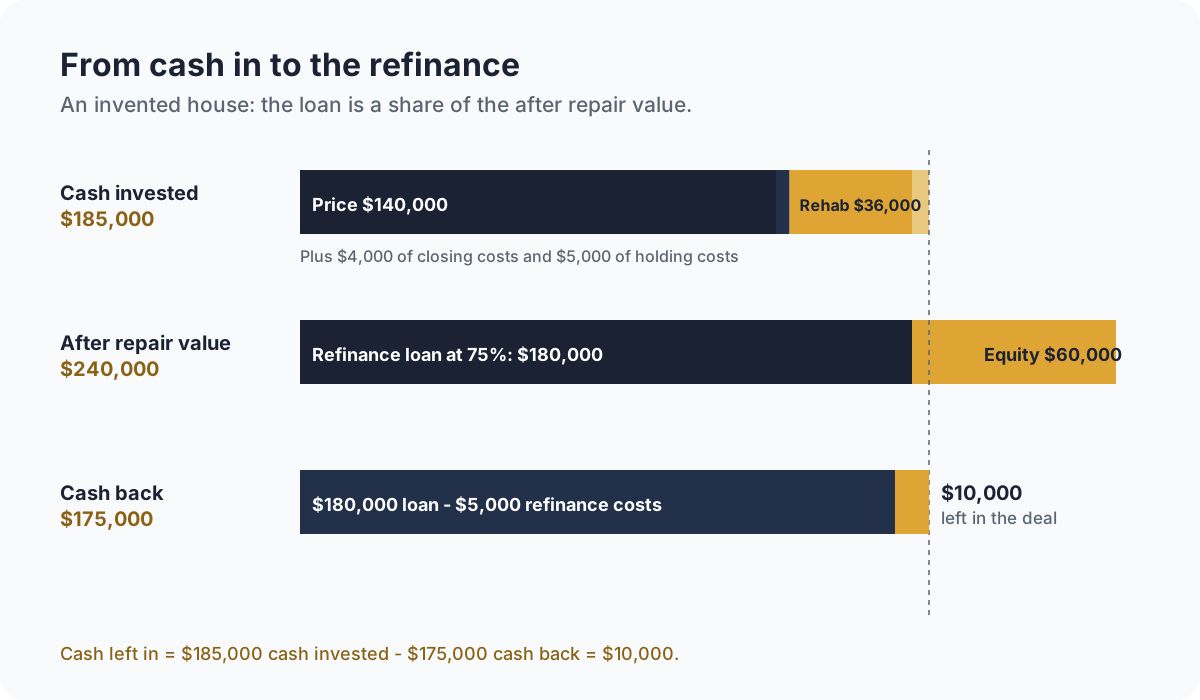
In a BRRRR deal you buy the property, do the work, rent it out, then refinance at the new value to take cash back out. The refinance loan is a share of the appraised value, the loan to value (LTV). Here is the same house, with figures that match the example in the BRRRR calculator:
| Step | Figure |
|---|---|
| Purchase price | $140,000 |
| Closing costs at purchase | $4,000 |
| Rehab | $36,000 |
| Holding costs during the work | $5,000 |
| Total cash invested | $185,000 |
| ARV, confirmed by the appraisal | $240,000 |
| Refinance loan at 75% LTV | $180,000 |
| Refinance closing costs | $5,000 |
| Cash back at the refinance | $175,000 |
| Cash left in the deal | $10,000 |
- Cash invested: $140,000 + $4,000 + $36,000 + $5,000 = $185,000.
- Refinance loan: $240,000 x 75% = $180,000. The 75% is for this example only; the share a lender will lend is set by your lender and your loan.
- Cash back: $180,000 - $5,000 = $175,000.
- Cash left in the deal: $185,000 - $175,000 = $10,000.
- Equity after the refinance: $240,000 - $180,000 = $60,000. The loan to value calculator works out LTV and equity from your own figures.
The house rents for $2,000 a month. With 5% vacancy and $600 a month of operating expenses, it brings in $2,000 x 95% = $1,900, and $1,900 - $600 = $1,300 a month before the loan. The payment on $180,000 at 7% over 30 years is $1,197.54, so the cash flow is $1,300 - $1,197.54 = $102.46 a month, or $1,229.47 a year. On the $10,000 left in, that is a cash-on-cash return of $1,229.47 / $10,000 = 12.29%. The cash on cash return calculator works the same measure for a property you already own.
Lenders on rental loans also look at whether the rent covers the payment. The debt service coverage ratio here is a year of income before the loan, $1,300 x 12 = $15,600, over a year of payments, $1,197.54 x 12 = $14,370.53, which is 1.09. The DSCR calculator works it out, and your lender sets the ratio it asks for.
When the appraisal comes in low
The lender lends against the appraisal, so an appraisal below your ARV means a smaller loan and more of your cash left in. If this house appraises at $220,000:
- Refinance loan: $220,000 x 75% = $165,000, which is $15,000 less than the $180,000 planned.
- Cash back: $165,000 - $5,000 = $160,000.
- Cash left in the deal: $185,000 - $160,000 = $25,000.
- The payment on $165,000 at 7% over 30 years is $1,097.75, so the cash flow is $1,300 - $1,097.75 = $202.25 a month, or $2,427.01 a year.
- Cash-on-cash return: $2,427.01 / $25,000 = 9.71%.
The smaller loan leaves more cash flow each month, and more of your money tied up in the house. Planning from the low end of your comp range leaves room if the appraisal comes in under the middle. Some lenders also ask you to own the property for a set period before they lend on the new value, so ask your lender about timing before you count on a date.
ARV and the rehab budget
The rehab budget and the ARV go together. The ARV only holds if the finished house matches the comps, so a budget cut that leaves out the new kitchen can leave the value short too. Many of the costs in a rehab are capital expenditures, such as a new roof, new windows or a new heating system, and how they are handled on your tax return depends on the work and your situation. Ask your tax professional. Keep every invoice and receipt for the work: you need them for your records, for the lender, and for your taxes when you sell.
Common ARV mistakes
- Using comps unlike your property. A bigger house, a different school zone or a newer build sells for a different price per square foot.
- Using old sales. Values move, so older sales say less about today's market.
- Counting on the top of the range. The lender's appraiser may not see the comps you saw.
- Assuming the work adds its cost to the value. $36,000 of work does not always add $36,000 of value. ARV comes from what similar finished homes sell for, whatever the work cost.
- Leaving out holding and refinance costs. Taxes, insurance, utilities and loan payments during the work, and the closing costs on the refinance, all add to the cash that stays in.
Frequently asked questions
What does ARV stand for in real estate?
After repair value: what a property should be worth once the planned repairs and upgrades are done.
How do you calculate ARV?
Find recent sales of similar, renovated homes nearby, work out each one's price per square foot, adjust for differences, and multiply by your property's square footage. In the example, 1,500 x $160 = $240,000.
Is ARV the same as the appraised value?
No. ARV is your estimate before the work is done. The appraised value is what the lender's appraiser says the property is worth when the lender orders the appraisal, and the refinance loan is based on it.
How much will a lender lend on the ARV?
It depends on the lender and the loan. The refinance is a share of the appraised value, and the share, the costs and any waiting period are set by your lender. Ask your lender before you run your numbers.
What happens to a BRRRR deal if the ARV is too high?
The appraisal comes in lower, the loan is smaller and more of your cash stays in the deal. In the example, a $220,000 appraisal leaves $25,000 in, against the $10,000 planned.
Track the rehab and the rent in one place
KeyRing keeps each property's income and expenses with categories you can edit, reads receipts you snap into expenses for you to confirm, and tracks vendor estimates and bills you approve. Once the property is rented, tenants pay online by bank transfer or card. See what KeyRing does or how plans are priced.
Free calculators and templates
- Cash on cash return calculatorYearly cash flow as a share of the cash you put in.
- DSCR calculatorHow many times NOI covers the loan payments, and the loan a target ratio allows.
- BRRRR calculatorCash in, cash back at the refinance and cash left in a buy, rehab, rent, refinance deal.
- Loan to value calculatorLTV, combined LTV and equity, with the room left under your lender's limit.
Browse all rental property calculators and free templates.