What is gross rent? Rent before expenses, and rent plus utilities

Gross rent is the total rent a rental property brings in before any expenses come out: no property taxes, insurance, repairs or mortgage subtracted. Investors usually mean the rent the units would bring at full occupancy, called gross scheduled rent, and compare it with the rent actually collected. A fourplex with four units at $1,250 a month has gross scheduled rent of $60,000 a year, and after one unit sat empty for a month it collected $58,750. In housing statistics the same words mean something else: the rent in the lease plus the utilities the tenant pays, so a $1,250 apartment where the tenant pays $150 a month in utilities has a gross rent of $1,400.
This page covers both meanings of gross rent, a worked fourplex example from each side, how gross rent differs from gross income and net operating income, where it shows up in deal analysis and tax records, and the mistakes that throw the figure off. It is general information and is not legal or tax advice. Rules vary by state and city. Check your local law or an attorney.
What is gross rent?
The word "gross" means before deductions. Gross rent is rent counted at the top of the page, before anything is subtracted from it. Who is doing the counting decides which deductions are left out, and that is where the two meanings come from.
For investors and owners, gross rent is the property's rental income before operating expenses and debt service. It comes in two versions:
- Gross scheduled rent (also called gross potential rent) is what every unit would bring if it were let for the whole period at its scheduled rent. Gross scheduled rent = monthly rent for all units x 12.
- Rent collected is what actually arrived. It is gross scheduled rent minus rent lost to empty units, concessions and unpaid rent.
In housing statistics, gross rent describes the tenant's side: the contract rent written in the lease plus the cost of utilities and fuels the tenant pays separately, such as electricity, gas, water or heating oil. Housing surveys and affordability studies use it so that an apartment with utilities included and one without can be compared fairly.
The two meanings rarely collide in practice. An investor reading a listing or a rent roll means the first. A report on rents and household incomes in a city usually means the second.
A worked example: a fourplex, from both sides
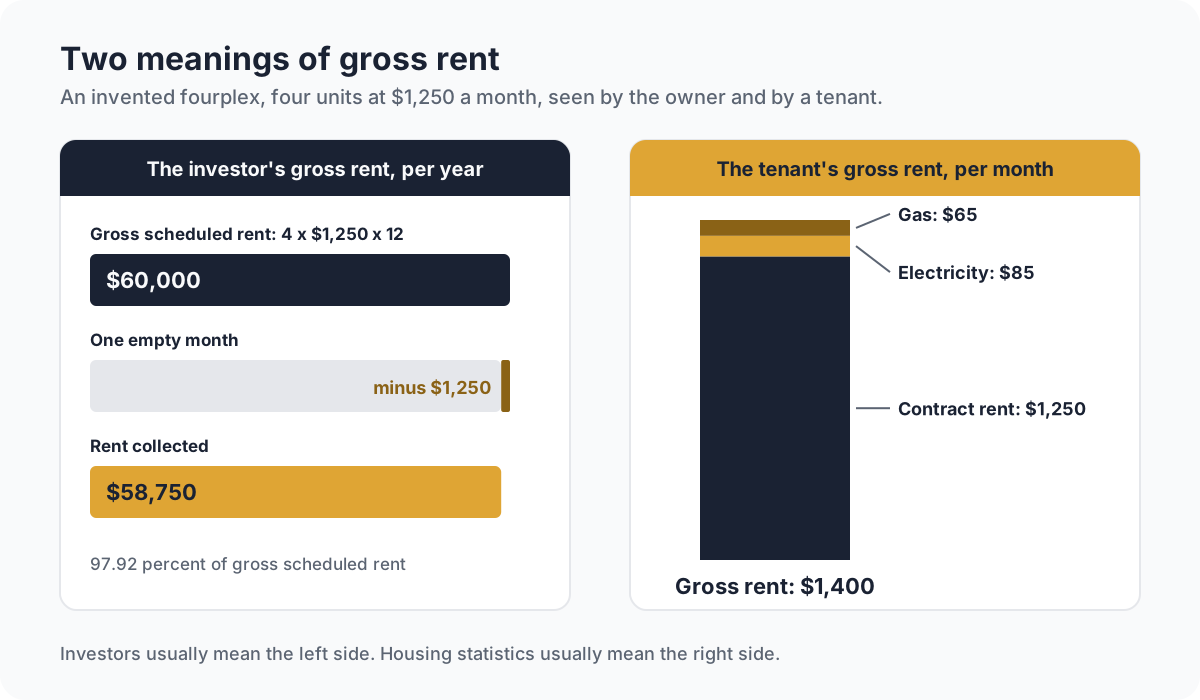
All the figures here are made up. A real estate investor owns a fourplex with four units at $1,250 a month each. The tenants pay their own electricity and gas, and the owner pays water, sewer and trash.
The investor's gross rent
- Monthly rent for all units: 4 x $1,250 = $5,000
- Gross scheduled rent for the year: $5,000 x 12 = $60,000
During the year, Unit 3 turned over and sat empty for one month. Every other payment arrived on time.
- Rent lost to the empty month: $1,250
- Rent collected: $60,000 minus $1,250 = $58,750
- Share of gross scheduled rent collected: $58,750 / $60,000 = 97.92 percent
The $1,250 gap is the property's economic vacancy for the year, 2.08 percent of gross scheduled rent. The vacancy rate guide covers how to measure it in days or months, and the vacancy rate calculator works it out from your own records.
The tenant's gross rent
Take the tenant in Unit 1. The lease says $1,250 a month. On top of that, the tenant pays an average of $85 a month for electricity and $65 a month for gas.
- Gross rent: $1,250 + $85 + $65 = $1,400 a month
- Over a year: $1,400 x 12 = $16,800
If that tenant earns $5,000 a month before taxes, the contract rent alone is 25.00 percent of income, and the gross rent is 28.00 percent. The rent-to-income ratio calculator does this comparison for any rent and income.
Gross rent, gross income and net operating income
Gross rent is the first line of a rental's income statement, and several other figures are built from it.
- Gross rent counts rent only.
- Gross income adds other income the property earns, such as laundry machines, parking, storage or pet fees. If the fourplex also took in $50 a month from a coin laundry, $600 a year, its gross scheduled income would be $60,600 while its gross rent stays $60,000.
- Effective gross income is gross income minus vacancy and credit loss, the money that actually came in.
- Net operating income (NOI) is effective gross income minus operating expenses such as taxes, insurance, repairs and management. The NOI guide walks through each line.
Suppose the fourplex's operating expenses for the year were $21,000. Its NOI from rent is $58,750 minus $21,000 = $37,750, before the laundry income and before any mortgage payment. Gross rent tells you how much the units can earn. NOI tells you what is left after running them, which is why lenders and appraisers lean on NOI and why two properties with the same gross rent can be very different investments.
Gross rent is also different from a gross lease. A gross lease is a lease where the owner pays most of the property's operating costs out of a single rent. The rent under a gross lease is still counted as gross rent, and so is the rent under a triple net lease, where the tenant pays a share of taxes, insurance and maintenance on top.
Where investors use gross rent
Quick comparisons. Because gross rent is easy to find, investors use it to compare listings before they have expense figures. The gross rent multiplier divides the price by gross annual rent. If the fourplex were listed at $600,000, its multiplier would be $600,000 / $60,000 = 10.00. The gross rent multiplier calculator works it out from a price and a monthly rent, and the multiplier guide covers its limits.
Gross yield. Gross annual rent divided by the price is the gross rental yield, here $60,000 / $600,000 = 10.00 percent. The rental yield calculator shows gross and net yield side by side.
Pro formas. A pro forma starts with gross scheduled rent and works down through vacancy, other income and expenses to NOI and cash flow. Every line below depends on the top one, so an inflated rent figure carries all the way through.
Rent rolls and seller figures. A seller's listing often quotes gross scheduled rent. Ask for the rent roll and a trailing twelve months of collections. The gap between the two shows vacancy, concessions and unpaid rent before you buy.
Gross rent and your tax records
In the United States, owners report the rent they receive on Schedule E, and the Schedule E guide walks through the form. For tax purposes, the figure generally follows rent actually received in the year, which is closer to rent collected than to gross scheduled rent. Some items have their own rules. Advance rent is generally income when you receive it, and a security deposit you expect to return is generally left out of income until you keep some of it. IRS Publication 527 covers residential rental property in general terms. A tax professional can tell you how these rules apply to your own records.
Keeping a month-by-month record of what each unit was due and what arrived makes both figures easy to produce. A rent tracker with one row per unit and one column per month shows gross scheduled rent on one line and collections on the next.
Common mistakes
- Mixing the two meanings. A housing report that says the typical gross rent in a city rose may be counting tenant-paid utilities. Compare it with listing rents only after checking which definition it uses.
- Quoting scheduled rent as income. A listing that shows gross scheduled rent assumes every unit is let all year at full rent. Plan from rent collected, or apply a vacancy allowance.
- Using asking rents for occupied units. If the current tenants pay less than the listing rent, gross scheduled rent is based on what the leases say today, with any planned increases shown separately.
- Stopping at gross rent. Two properties with the same gross rent can have very different taxes, insurance and repair bills. Carry the analysis through to NOI before deciding.
Frequently asked questions
Is gross rent the same as rental income?
For most investors, gross rent is the rental part of income before any expenses. Rental income on a tax return generally follows rent received in the year, and gross income adds other sources such as laundry or parking. In the fourplex example, gross scheduled rent is $60,000 and rent collected is $58,750.
How do you calculate gross rent for a rental property?
Add up the monthly rent for every unit and multiply by 12. Four units at $1,250 a month give gross scheduled rent of $5,000 a month, or $60,000 a year. Subtract rent lost to vacancy, concessions and unpaid rent to get rent collected.
Does gross rent include utilities?
In housing statistics it does: gross rent is the contract rent plus the utilities the tenant pays. A $1,250 rent with $85 of electricity and $65 of gas is a gross rent of $1,400 a month. When investors talk about gross rent, they usually mean the rent in the leases only.
What is the difference between gross rent and net rent?
Gross rent is rent before any expenses. Net figures subtract something: net operating income takes out operating expenses, and some commercial leases use net rent for rent paid on top of the tenant's share of costs. In the example, $58,750 of rent collected minus $21,000 of operating expenses leaves $37,750 of NOI.
Why do investors care about gross rent?
It is the top line every other figure is built from, and it is easy to compare across listings. The gross rent multiplier and gross yield use it directly. It leaves out expenses, so investors use it to narrow a list and then check NOI before deciding.
Track what each unit is due and what arrives
Gross rent is easier to measure when every payment is already recorded against its property. In KeyRing, you connect your bank accounts securely through Plaid, and each transaction is matched to a property with suggestions you confirm. Income and expense records use categories you can edit, and you can export your transactions to Excel. See what KeyRing does or how plans are priced.
Free calculators and templates
- Gross rent multiplier calculatorPrice over a year of gross rent, and the price your target GRM supports.
- Vacancy rate calculatorThe share of the time units sat empty, and the rent it cost.
- Rent to income ratio calculatorRent as a share of gross income, and the income needed at your target.
- Rent tracker templateEvery unit on one row and every month in a column, so a year of rent fits on one page.
Browse all rental property calculators, free templates and the glossary.
From the blog
- What is NOI? Net operating income for rental propertyNOI is a rental property's income after vacancy and operating expenses, before the mortgage. What goes in, what stays out, a duplex example and its uses.
- What is a rent roll (with a free template)A rent roll lists each unit, tenant, lease and rent in a property as of one date. See what it includes, a fourplex example and the numbers you can pull from it.
- What is Schedule E? Rental income and expenses, line by lineSchedule E (Form 1040) is the IRS form for rental income and expenses. See who files it, the lines for rent, expenses and depreciation, and when it is due.