What is appreciation in real estate? How property value grows

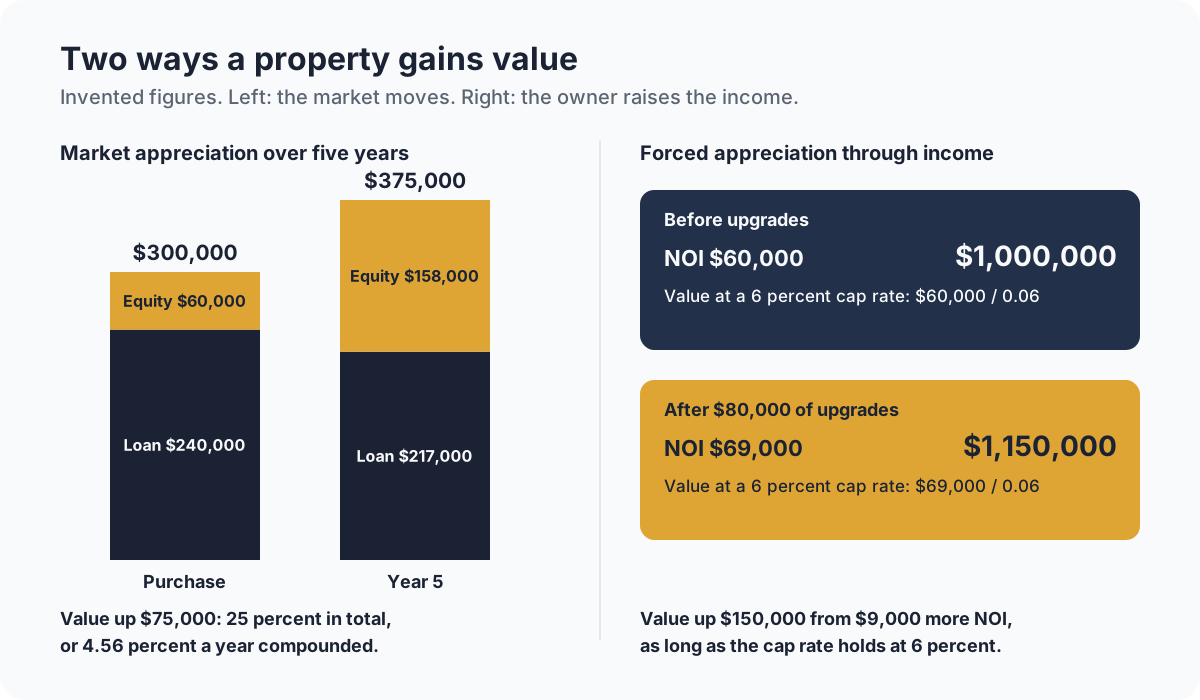
Appreciation is the rise in a property's value over time. It comes from two places: the market, when buyers in the area will pay more for the same property, and the owner, when improvements or higher income make the property worth more. A rental bought for $300,000 and worth $375,000 five years later has appreciated by $75,000, which is 25 percent in total or 4.56 percent a year compounded.
This page covers what appreciation is, market and forced appreciation, how to work out total and yearly appreciation, how it builds equity, how it differs from depreciation and what happens to it when you sell. It is general information and is not legal or tax advice. Rules vary by state and city. Check your local law or an attorney.
What is appreciation in real estate?
Appreciation is the increase in what a property is worth, measured from one date to another. It is usually measured from the purchase price to today's value or to the sale price.
Appreciation = current value minus purchase price
The opposite, a fall in value, is called depreciation in everyday speech. That word also has a separate tax meaning, covered below, and the two are easy to mix up.
Appreciation is one of the ways a rental property earns a return, alongside the cash flow from rent and the loan principal that the rent pays down. The rental property ROI calculator adds those three together for one year, using an appreciation rate you enter.
Appreciation is unrealized while you own the property. Only the sale price turns it into cash. Until then it shows up as equity: you can borrow against it or count it on a balance sheet, but the number is an estimate.
Market appreciation and forced appreciation
Market appreciation is value that rises because of things outside the property: more demand for housing in the area, new jobs nearby, rising building costs, lower interest rates or a neighborhood becoming more popular. The owner does nothing to the property itself. It can also run the other way, and values can fall for years at a time.
Forced appreciation is value the owner creates. It comes from changes to the property or to how it is run:
- Improvements. A renovated kitchen, an added bedroom or a finished basement can make a home worth more to buyers. The ARV guide explains how investors estimate the after-repair value before they buy.
- Higher income. For rental property, especially apartment buildings and commercial property, value is often set from the income. Raising rents after upgrades, adding parking or laundry income, or cutting operating expenses raises the net operating income, and with it the value.
Forced appreciation usually costs money, and the CapEx guide covers how owners plan for that kind of spending. It only pays off when the value added is larger than the cost.
How income sets the value: the cap rate
Income property is often valued by dividing its net operating income by a capitalization rate, the return buyers in that market expect from similar property.
Value = net operating income / cap rate
The cap rate guide explains where the rate comes from, and the NOI guide shows how NOI is built from rent and expenses. Because of the division, each extra dollar of yearly NOI adds many dollars of value. At a 6 percent cap rate, one dollar of NOI is worth $1 / 0.06, or about $16.67 of value.
The same formula shows the risk. If buyers start asking for a higher cap rate, the value falls even when the NOI holds steady. Forced appreciation and market movement act on the same number.
A worked example: market appreciation
All the figures here are made up. A real estate investor buys a single-family rental for $300,000 with a $240,000 loan, so the starting equity is $300,000 minus $240,000 = $60,000. Five years later a similar home nearby sells for $375,000, and the investor uses that as the current value.
Total appreciation
- In dollars: $375,000 minus $300,000 = $75,000
- As a percent: $75,000 / $300,000 = 25 percent
Yearly (compound) appreciation
Dividing 25 percent by five years gives 5 percent, but that overstates the yearly rate, because each year's growth builds on the year before. The compound annual rate uses this formula:
Annual appreciation rate = (ending value / starting value) ^ (1 / years) minus 1
- $375,000 / $300,000 = 1.25
- 1.25 ^ (1 / 5) = 1.0456
- 1.0456 minus 1 = 4.56 percent a year
To check it, a full 5 percent a year compounded for five years would take $300,000 to $382,884.47, more than the $375,000 the home is worth. The 4.56 percent rate lands on $375,000.
Equity
Over the same five years the rent has paid the loan down from $240,000 to $217,000. Equity is now $375,000 minus $217,000 = $158,000, up $98,000 from the start. Of that, $75,000 came from appreciation and $23,000 from principal paydown. The loan-to-value ratio has dropped from 80 percent to $217,000 / $375,000 = 57.87 percent, which matters if the investor wants to refinance or borrow against the property.
A worked example: forced appreciation
All the figures here are made up. An investor owns a 10-unit building with $60,000 of NOI. Similar buildings in the area trade at a 6 percent cap rate.
- Value today: $60,000 / 0.06 = $1,000,000
The investor spends $80,000 updating the units. Afterward the market supports $75 a month more rent on each unit, and operating expenses stay the same.
- Extra NOI: $75 x 10 units x 12 months = $9,000 a year
- New NOI: $60,000 + $9,000 = $69,000
- New value at the same cap rate: $69,000 / 0.06 = $1,150,000
- Value added: $1,150,000 minus $1,000,000 = $150,000
- Value added beyond the cost: $150,000 minus $80,000 = $70,000
If cap rates in the area moved up to 6.5 percent over the same period, the building would be worth $69,000 / 0.065 = $1,061,538.46, and most of the gain from the upgrades would be gone. Forced appreciation is within the owner's control. The cap rate is not.
Appreciation and depreciation are different things
In tax terms, depreciation is a yearly deduction for the wear on a rental building. In the United States, a residential rental building is usually depreciated over 27.5 years, and land is never depreciated. The deduction applies whether the property's market value is rising or falling.
So a rental can appreciate in the market while you claim depreciation on your tax return every year. The two do meet at the sale: each year's depreciation lowers your adjusted basis, the figure your gain is measured from, so the taxable gain is often larger than the appreciation alone.
What happens to appreciation when you sell
Appreciation becomes a taxable gain when you sell. In broad terms, the gain is the sale price minus selling costs, minus the adjusted basis (what you paid plus improvements, minus the depreciation you have taken).
Back to the single-family rental, with purchase costs left out to keep it simple. Say $220,000 of the $300,000 price was the building, so depreciation was $220,000 / 27.5 = $8,000 a year, or $40,000 over five years. The investor sells for $375,000 and pays $22,500 in selling costs.
- Adjusted basis: $300,000 minus $40,000 = $260,000
- Amount realized: $375,000 minus $22,500 = $352,500
- Total gain: $352,500 minus $260,000 = $92,500
The appreciation was $75,000, yet the gain is $92,500. Under federal rules the $40,000 of depreciation taken is usually taxed as depreciation recapture, and the remaining $52,500 as a long-term capital gain when the property was held more than a year. The capital gains tax calculator works through the same split with your own figures and rates. A 1031 exchange can defer the tax when you buy another investment property. State tax rules differ, so ask a tax professional before you sell.
Common mistakes
- Using the simple average as the yearly rate. Total percent divided by years overstates the compound rate. Use the formula above.
- Counting the cost of improvements as appreciation. A $50,000 renovation that adds $50,000 of value has added equity you paid for. Compare value added with what you spent.
- Treating an estimate as cash. An online estimate or a neighbor's sale is a guide. A lender's appraisal or an actual sale sets the number that counts.
- Leaving out selling costs and tax. The cash from appreciation is what remains after commissions, closing costs, the loan payoff and tax.
- Buying for appreciation alone. A property that loses money every month needs values to rise just to break even. Many investors want the rent to cover the costs first and treat market appreciation as a bonus.
Frequently asked questions
What is appreciation in real estate in simple terms?
It is the increase in what a property is worth over time. A home bought for $300,000 and worth $375,000 later has appreciated by $75,000.
How do you calculate the yearly appreciation rate?
Divide the ending value by the starting value, raise the result to the power of 1 divided by the number of years, and subtract 1. For $300,000 growing to $375,000 over five years, that is 1.25 ^ (1 / 5) minus 1, or 4.56 percent a year.
What is forced appreciation?
It is value the owner adds through improvements, higher rent, extra income or lower operating expenses. For income property valued by cap rate, $9,000 more NOI at a 6 percent cap rate adds $150,000 of value.
Is appreciation taxed every year?
In general, no. Appreciation is unrealized until you sell. At the sale, the gain over your adjusted basis is usually taxed, with the part equal to the depreciation you took often taxed as recapture. Ask a tax professional about your situation.
What is the difference between appreciation and depreciation?
Appreciation is a rise in market value. Depreciation, for tax purposes, is a yearly deduction for the wear on a rental building, taken whatever the market does. Depreciation lowers your basis, which makes the taxable gain larger when you sell.
Keep the records that show what you have put in
When you sell, the gain depends on what you paid, the improvements you made and the depreciation you took, so the records from every year of ownership matter. In KeyRing, you connect your bank accounts securely through Plaid, and each transaction is matched to a property with suggestions you confirm. Income and expense records use categories you can edit, and you can export your transactions to Excel. See what KeyRing does or how plans are priced.
Free calculators and templates
- Capital gains tax on rental property calculatorThe gain on selling a rental, the tax on it and the cash you keep.
- Rental property ROI calculatorOne year's total return from cash flow, loan paydown and appreciation.
- BRRRR calculatorCash in, cash back at the refinance and cash left in a buy, rehab, rent, refinance deal.
- Rental property balance sheet templateAssets, liabilities and equity for one property at year end, next to last year's.
Browse all rental property calculators, free templates and the glossary.
From the blog
- What is cap rate? How to calculate it for a rental propertyCap rate is net operating income divided by a property's price or value. How to calculate it, a worked fourplex example and what it leaves out.
- What is NOI? Net operating income for rental propertyNOI is a rental property's income after vacancy and operating expenses, before the mortgage. What goes in, what stays out, a duplex example and its uses.
- What is ARV? After repair value for BRRRR investorsARV is what a property should be worth once the repairs are done. How to estimate it from comparable sales, and how it sets a BRRRR refinance, with an example.