What is a 1031 exchange? Like-kind exchanges for rental property

A 1031 exchange is a sale of one investment or business property followed by the purchase of another, set up so the tax on the gain from the sale is deferred. It takes its name from Section 1031 of the US Internal Revenue Code, and it is also called a like-kind exchange or a tax-deferred exchange. A real estate investor who sells a rental house and buys a small apartment building through a 1031 exchange can carry the gain into the new property and pay tax on it later, usually when the new property is sold in a taxable sale.
This page covers what a 1031 exchange is, which property qualifies, the 45-day and 180-day deadlines, the role of the qualified intermediary, a worked example with the gain, the deferred tax basis and boot, and the mistakes that can turn an exchange into a taxable sale. It is general information and is not legal or tax advice. Federal tax rules change, and state tax treatment differs, so talk to a tax professional and a qualified intermediary before you list a property. Rules vary by state and city. Check your local law or an attorney.
What is a 1031 exchange?
When you sell a rental for more than its adjusted basis, the difference is a gain, and part of it is usually taxed in the year of the sale. That includes tax on the depreciation you claimed while you owned it. A 1031 exchange postpones that tax. You sell the old property (the relinquished property), buy one or more new ones (the replacement property) within set deadlines, and never take the sale money into your own hands in between.
The gain is deferred. The tax is still there: the gain you did not pay tax on lowers the tax basis of the replacement property, so it shows up again when that property is sold, unless it is exchanged again.
Gain = sale price minus selling costs minus adjusted basis
Adjusted basis = purchase price plus improvements minus depreciation claimed
The 1031 exchange calculator estimates the tax an exchange would defer, and the capital gains tax calculator estimates the tax on a regular sale for comparison.
Which property qualifies
- Real property held for investment or for use in a business. A rental house, a duplex, a small apartment building, a storefront, a warehouse and raw land held for investment can all qualify.
- Like-kind means real property for real property. The type can change. A single-family rental can be exchanged for an apartment building, a storefront or land held for investment, as long as both are held for investment or business use. Property in the United States and property outside it are not like-kind to each other.
- Your home does not qualify for a 1031 exchange. A home you live in is covered by a separate rule for the sale of a main home.
- Property held mainly for sale does not qualify. A house bought to renovate and resell quickly, a flip, is held for sale, so it falls outside Section 1031.
- Personal property does not qualify. Since 2018, Section 1031 covers real property only, so furniture and appliances sold with a rental are outside the exchange.
The same taxpayer that sells should buy. If your company owns the old rental, the company usually takes title to the replacement.
The 45-day and 180-day deadlines
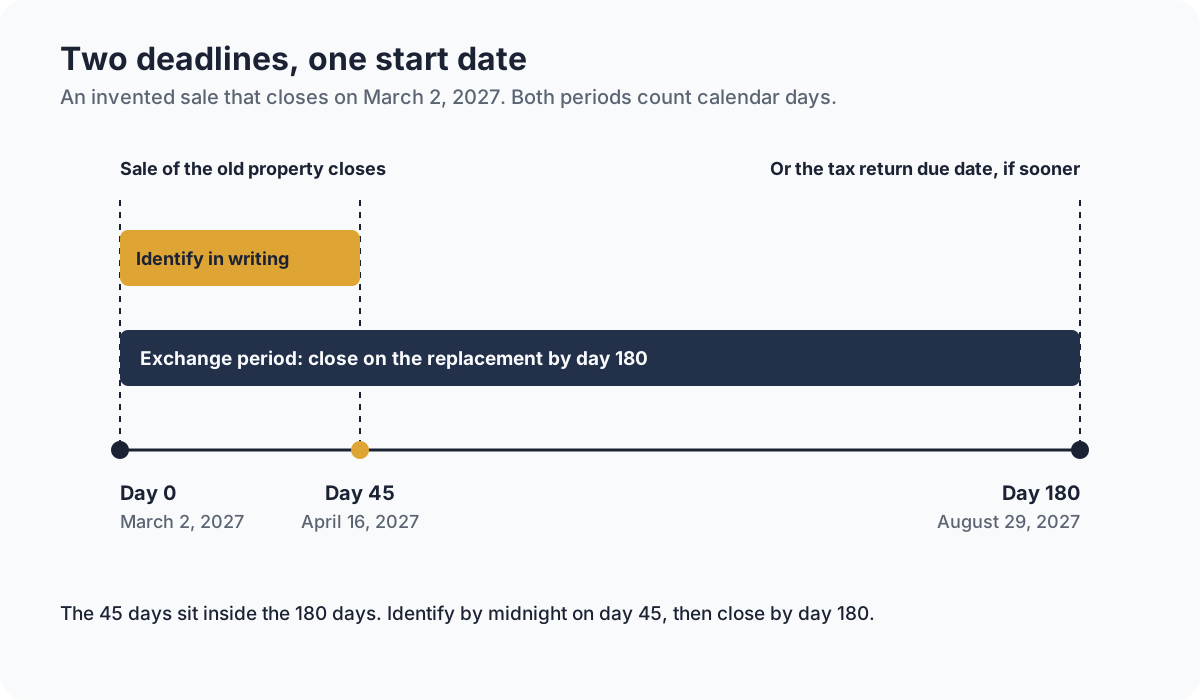
Two deadlines run from the day the relinquished property is transferred, and both count calendar days, weekends and holidays included:
| Deadline | What must happen | Counted from |
|---|---|---|
| Day 45 | Identify the possible replacement properties in writing | The day the old property's sale closes |
| Day 180 | Close on the replacement property | The same day, and no later than your tax return due date, with extensions, for that year |
The two periods run at the same time. Day 45 is inside the 180 days, so a sale that closes on March 2, 2027 has an identification deadline of April 16, 2027 and an exchange deadline of August 29, 2027.
Identification has its own rules. The three most used are:
- The three-property rule. Name up to three properties of any value.
- The 200 percent rule. Name any number of properties, as long as their combined fair market value is no more than 200 percent of the value of the property you sold.
- The 95 percent rule. Name more than that, but then you must acquire properties worth at least 95 percent of the combined value you named.
Put the identification in writing, sign it and deliver it to the qualified intermediary or another person the rules allow by midnight on day 45, with an address or legal description for each property.
The qualified intermediary
You cannot hold the money from the sale, even for a day, and still defer the gain. A qualified intermediary, sometimes called an exchange accommodator, holds the sale proceeds and uses them to buy the replacement property for you. The intermediary signs on before the sale closes, so the closing instructions route the money straight to them.
The intermediary cannot be someone who has recently acted as your agent, such as your attorney, real estate agent, accountant or employee, or a close relative. Ask how the intermediary holds the funds and whether the account is kept apart from their own money.
A worked example
All the figures here are made up for this example. A real estate investor bought a single-family rental for $300,000 and has claimed $50,000 of depreciation, so the adjusted basis is $300,000 minus $50,000 = $250,000.
The investor sells it for $400,000 and pays $24,000 in selling costs:
- Amount realized: $400,000 minus $24,000 = $376,000
- Gain: $376,000 minus $250,000 = $126,000
In a regular sale, the $126,000 gain is taxed in the year of the sale, with the $50,000 of depreciation usually taxed under the depreciation recapture rules. The depreciation recapture calculator shows how that part is worked out.
Through a 1031 exchange, the investor buys a fourplex for $500,000, using all the sale proceeds and a new mortgage. None of the $126,000 is taxed now. The fourplex's starting tax basis is its price minus the deferred gain:
- Basis of the replacement: $500,000 minus $126,000 = $374,000
That lower basis is how the deferred gain is carried forward. Depreciation on the fourplex is figured from the carried-over basis, and when the fourplex is sold in a taxable sale, the old gain and the new one are taxed together.
When part of the gain is taxed: boot
Anything you receive in the exchange that is not like-kind property is called boot, and it is usually taxed, up to the amount of the gain. Cash you keep from the sale is boot. So is a drop in debt: if the mortgage you pay off on the old property is larger than the debt on the new one, and you do not add cash to make up the difference, the difference can be boot too.
Suppose the investor in the example kept $20,000 of the proceeds to repaint other rentals. Then $20,000 of the $126,000 gain is generally taxed now and $126,000 minus $20,000 = $106,000 is deferred. To defer all the gain, the usual rule of thumb is to buy replacement property of equal or greater value and reinvest all the net proceeds.
| Taxable sale | Full 1031 exchange | Exchange, $20,000 cash kept | |
|---|---|---|---|
| Gain on the sale | $126,000 | $126,000 | $126,000 |
| Gain taxed now | $126,000 | $0 | $20,000 |
| Gain deferred | $0 | $126,000 | $106,000 |
Reporting a 1031 exchange
A 1031 exchange is reported on IRS Form 8824 with your tax return for the year the old property was sold. The form shows the properties, the dates, the gain deferred and any boot. Rental income and expenses for the year still go on the Schedule E, and the new property's depreciation starts from the carried-over basis.
Keep the closing statements for both properties, the exchange agreement, the identification letter and the intermediary's account statement for your tax professional. Improvements you make to the new property later add to its basis, and the CapEx guide covers how they are treated. A rental property balance sheet is a good place to record the new property, the new mortgage and the carried-over basis.
Common 1031 exchange mistakes
- Touching the money. If the proceeds land in your own account, the exchange usually fails. Sign the intermediary on before closing.
- Missing day 45 or day 180. The deadlines are counted in calendar days and generally are not extended for weekends. Start looking for the replacement before you list the old property.
- Changing the owner. Selling in one name and buying in another can break the exchange. Plan the title before you sign.
- Forgetting the debt. Paying off a larger mortgage than you take on can create boot even when no cash changes hands.
- Skipping the numbers. Compare the cap rate of the old and new properties before you commit.
Frequently asked questions
What is a 1031 exchange in simple terms?
A 1031 exchange is selling one investment property and buying another under set rules, so the tax on the gain from the sale is postponed. The gain carries over into the new property and is taxed when that property is sold in a regular sale.
What are the 1031 exchange deadlines?
You have 45 days from the sale of the old property to identify replacement properties in writing, and 180 days from the same sale to close on the replacement, or your tax return due date for that year if it comes first. Both periods count calendar days.
Can I do a 1031 exchange on my house?
Usually no. The home you live in does not qualify, and a separate federal rule covers the sale of a main home. Talk to a tax professional if a property has been both a home and a rental.
What is boot in a 1031 exchange?
Boot is anything you receive in the exchange that is not like-kind property, such as cash you keep or a reduction in your mortgage debt. Boot is generally taxed in the year of the exchange, up to the amount of the gain.
Does a 1031 exchange avoid taxes forever?
It defers them. The deferred gain lowers the tax basis of the replacement property, so it is taxed when that property is sold in a taxable sale. Rules vary by state and city, and state income tax treatment can differ. Check your local law or an attorney.
Keep every property's numbers ready for the next move
A 1031 exchange starts with knowing what each property earns and costs. In KeyRing, you connect your bank accounts securely through Plaid, and each transaction is matched to a property with suggestions you confirm. Income and expense records use categories you can edit, and you can export your transactions to Excel for your tax professional. See what KeyRing does or how plans are priced.
Free calculators and templates
- 1031 exchange calculatorThe gain a 1031 exchange defers, the boot taxed now and the new property's basis.
- Capital gains tax on rental property calculatorThe gain on selling a rental, the tax on it and the cash you keep.
- Depreciation recapture calculatorThe tax on the depreciation part of a rental sale, and the capital gain on the rest.
- Rental property balance sheet templateAssets, liabilities and equity for one property at year end, next to last year's.
Browse all rental property calculators, free templates and the glossary.
From the blog
- What is Schedule E? Rental income and expenses, line by lineSchedule E (Form 1040) is the IRS form for rental income and expenses. See who files it, the lines for rent, expenses and depreciation, and when it is due.
- What is CapEx? Capital expenditures vs repairs on a rentalCapEx is money spent on a rental that lasts for years, such as a new roof. How it differs from a repair, how it is taxed and how to budget a CapEx reserve.
- What is cap rate? How to calculate it for a rental propertyCap rate is net operating income divided by a property's price or value. How to calculate it, a worked fourplex example and what it leaves out.