What is a turnkey property? Buying a rental that is ready to go

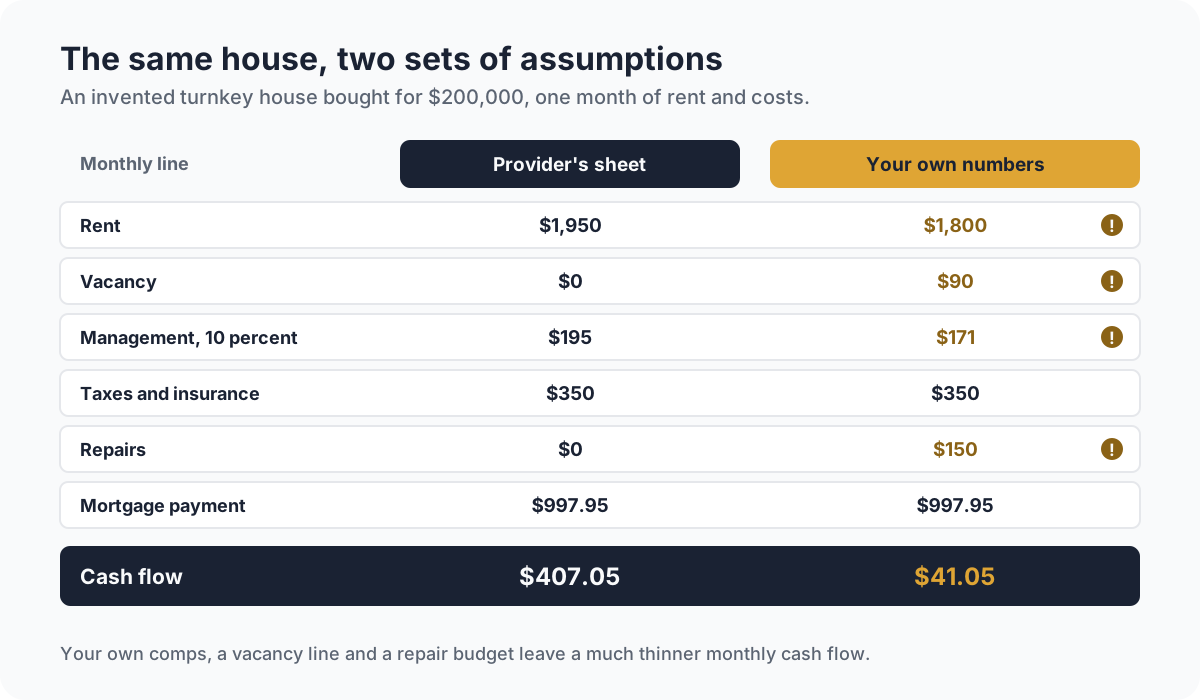
A turnkey property is a rental home sold already renovated and ready to rent, often with a tenant on a lease and a property manager in place. Many are sold by turnkey providers to real estate investors who live in another state, and the provider's numbers need checking. In the example on this page, the provider's sheet shows $407.05 a month of cash flow, and the same house run with the investor's own rent and costs shows $41.05.
This page covers what turnkey means, how buying from a turnkey provider works, the pros and cons, what to check before you buy, a worked example run through the site's calculators and the mistakes that throw the numbers off. It is general information and is not legal or tax advice. Rules vary by state and city. Check your local law or an attorney.
What is a turnkey property?
The name comes from the idea that you turn the key and the property works. The repairs and updates are done, and a tenant can move in, or already has. The buyer's job is to own it and keep an eye on the numbers.
Most turnkey sales fall into one of two shapes:
- Renovated and vacant. The work is finished and the house is ready for a tenant. The provider or its manager places one after closing.
- Renovated and tenanted. A tenant has already signed a lease, so rent starts on day one. The buyer takes over that lease and the tenant's security deposit.
Turnkey sits at the opposite end from a BRRRR deal. A BRRRR investor buys a house that needs work and does the rehab to add value. A turnkey buyer pays a price that already includes the rehab, and the provider keeps the margin on that work. You give up some of the upside in exchange for a property that is finished when you buy it.
How buying from a turnkey provider works
A turnkey provider buys houses, renovates them and sells them to investors as rentals. Many also manage them after closing. The steps usually look like this:
- The provider lists a property. You get a sheet with the price, a photo set, a scope of the work done, the expected rent and a projection of income and costs. That projection is a pro forma: a forecast, prepared by the seller.
- You make an offer and arrange financing. Many turnkey buyers use a standard investment property mortgage, since the house is in good condition.
- You arrange your own inspection. Hire an inspector with no tie to the provider.
- You review the lease and the management agreement. If a tenant is in place, you read the lease, the rent ledger and the deposit amount. If the provider's company will manage the house, you read its agreement and fee schedule.
- You close. The manager collects rent, handles repairs and sends you a monthly statement.
Some providers offer a short warranty on the renovation work, or a rent guarantee for the first months. Read exactly what each one covers and when it ends.
Pros and cons of a turnkey property
Pros
- Less work up front. No rehab to run.
- Rent can start right away, especially when a tenant is already in place.
- Easier financing. A house in good condition usually qualifies for a standard rental mortgage.
- Access to other markets. You can buy where the numbers work, with a manager on the ground.
Cons
- You pay retail for the rehab. The provider's profit on the work is in the price, so there is less room for instant equity.
- The numbers come from the seller. The rent, the vacancy and the expense lines on the sheet are the provider's estimates.
- Conflicts of interest. When the seller also manages the house, the manager may be slow to report problems with work its own company did.
- Distance. You may never see the house, so every check comes through reports and photos.
- Quality varies. Fresh paint and new flooring can hide an old roof or furnace.
What to check before you buy
Most of the risk sits in what the buyer takes on faith. The rental inspection checklist is a good base for these checks, room by room:
- An independent inspection. Ask the inspector to note the age of the roof, the heating and cooling system, the water heater and the electrical panel. Those are the large replacements the CapEx guide covers, and a turnkey rehab may have left them alone.
- The lease and the tenant's payment history. Read the lease itself, check the start date and end date, and ask for the rent ledger. A tenant placed a few weeks before the sale has no track record yet.
- The rent against your own comps. Look up what similar homes nearby actually rent for, from listings and from local managers. If the provider's rent is at the top of that range, plan from the middle.
- The manager's fees. Ask for the full fee schedule: the monthly fee, the leasing fee for a new tenant, any renewal fee and any markup on repairs. The property manager guide explains the common fee types.
- The vacancy and repair lines. A projection with neither looks better than any real year. Add both back.
- Property taxes and insurance. Taxes often reset after a sale. Get a quote for your own policy.
- The scope of the renovation. Ask for permits, invoices and before and after photos.
A worked example: a turnkey house out of state
All the figures here are made up. A real estate investor buys a renovated single-family house in another state for $200,000, with a tenant in place. She puts $50,000 down, pays $5,000 in closing costs and borrows $150,000 at 7 percent over 30 years. The provider's company will manage the house for 10 percent of the rent collected. Property taxes are $250 a month and insurance is $100 a month.
The provider's sheet shows rent of $1,950, no vacancy and no repair budget. Her own comps put the rent at $1,800, and she plans for 5 percent vacancy and $150 a month for repairs. Both versions run through the rental cash flow calculator:
| Monthly line | Provider's sheet | Her numbers |
|---|---|---|
| Rent | $1,950 | $1,800 |
| Vacancy | $0 | $90 |
| Rent collected | $1,950 | $1,710 |
| Management, 10 percent | $195 | $171 |
| Taxes and insurance | $350 | $350 |
| Repairs | $0 | $150 |
| Operating expenses | $545 | $671 |
| Net operating income | $1,405 | $1,039 |
| Mortgage payment | $997.95 | $997.95 |
| Cash flow | $407.05 | $41.05 |
Her numbers, step by step:
- Rent collected: $1,800 x 0.95 = $1,710 a month
- Management: $1,710 x 0.10 = $171
- Operating expenses: $171 + $250 + $100 + $150 = $671
- Net operating income: $1,710 minus $671 = $1,039 a month, or $12,468 a year
- Mortgage payment on $150,000 at 7 percent over 30 years: $997.95 a month
- Cash flow: $1,039 minus $997.95 = $41.05 a month, or $492.56 a year
The provider's sheet, by the same steps, gives $1,950 minus $545 = $1,405 of NOI and $1,405 minus $997.95 = $407.05 a month of cash flow, or $4,884.56 a year.
Cash invested is $50,000 + $5,000 = $55,000. On her numbers the cash on cash return is $492.56 / $55,000 = 0.90 percent, against $4,884.56 / $55,000 = 8.88 percent on the provider's sheet. The cap rate on her NOI is $12,468 / $200,000 = 6.23 percent; the cap rate guide explains that measure.
The rental property ROI calculator adds the first year's loan paydown, $1,523.71, and an invented 2 percent rise in value, $200,000 x 0.02 = $4,000: $492.56 + $1,523.71 + $4,000 = $6,016.27, an ROI of $6,016.27 / $55,000 = 10.94 percent. Most of that is paper gain until she sells. The rental property calculator shows all three measures from the same inputs.
The break-even rent tells her how much cushion she has: ($250 + $100 + $150 + $997.95) / (0.95 x 0.90) = $1,751.99. Rent could fall less than $50 below her $1,800 before the house needs money from her. The deal may still suit her, and she now knows the cash flow is thin.
Common mistakes
- Planning from the provider's rent. Use your own comps, and plan from the middle of the range.
- Leaving out vacancy and repairs. Every rental has empty months and repairs at some point. The vacancy rate guide shows how to set the vacancy line.
- Skipping the monthly statements. Compare each statement with your bank deposits, and ask about any repair you did not expect.
- Treating a rent guarantee as the real rent. Plan from what the house earns after the guarantee ends.
Frequently asked questions
What does turnkey mean in real estate?
It means the property is ready to use as soon as you buy it. For a rental, the renovation is done, the home is ready for a tenant or already has one, and a property manager is often lined up.
Are turnkey properties a good investment?
It depends on the price and the numbers. One can suit an investor who wants less hands-on work, as long as the rent and costs hold up against your own research. In the example, the same house shows $407.05 a month on the provider's sheet and $41.05 on the investor's numbers.
Who manages a turnkey property after the sale?
Often the provider's own management company, though you can usually hire a different one. Read the management agreement before closing, including how either side can end it.
Should I get an inspection on a turnkey property?
Yes. Hire your own inspector, with no tie to the provider, and ask for the age and condition of the roof, the heating and cooling system, the water heater and the electrical panel.
How do I check a turnkey provider's rent estimate?
Look up what similar homes nearby actually rent for, from listings and local property managers, and ask for the lease and rent ledger if a tenant is in place. Then run both rents through a cash flow calculator.
Keep your own records of a property you rarely see
A rental in another state is easier to watch when every deposit and every expense is already filed under its property. In KeyRing, you connect your bank accounts securely through Plaid, and each transaction is matched to a property with suggestions you confirm. Income and expense records use categories you can edit, and you can export your transactions to Excel. See what KeyRing does or how plans are priced.
Free calculators and templates
- Rental cash flow calculatorMonthly cash flow line by line, per unit, with the break-even rent.
- Rental property ROI calculatorOne year's total return from cash flow, loan paydown and appreciation.
- Rental property calculatorCash flow, cap rate, cash on cash return and ROI for one property, all at once.
- Rental inspection checklistA room by room check of an occupied rental, with the repairs it turns up.
Browse all rental property calculators, free templates and the glossary.
From the blog
- What is a property manager? What one does and when to hire oneA property manager runs rentals for an owner: tenants, rent, repairs and records. What one does, how fees work, when to hire one and what to ask first.
- What is cap rate? How to calculate it for a rental propertyCap rate is net operating income divided by a property's price or value. How to calculate it, a worked fourplex example and what it leaves out.
- What is CapEx? Capital expenditures vs repairs on a rentalCapEx is money spent on a rental that lasts for years, such as a new roof. How it differs from a repair, how it is taxed and how to budget a CapEx reserve.