What is BRRRR? Buy, rehab, rent, refinance, repeat
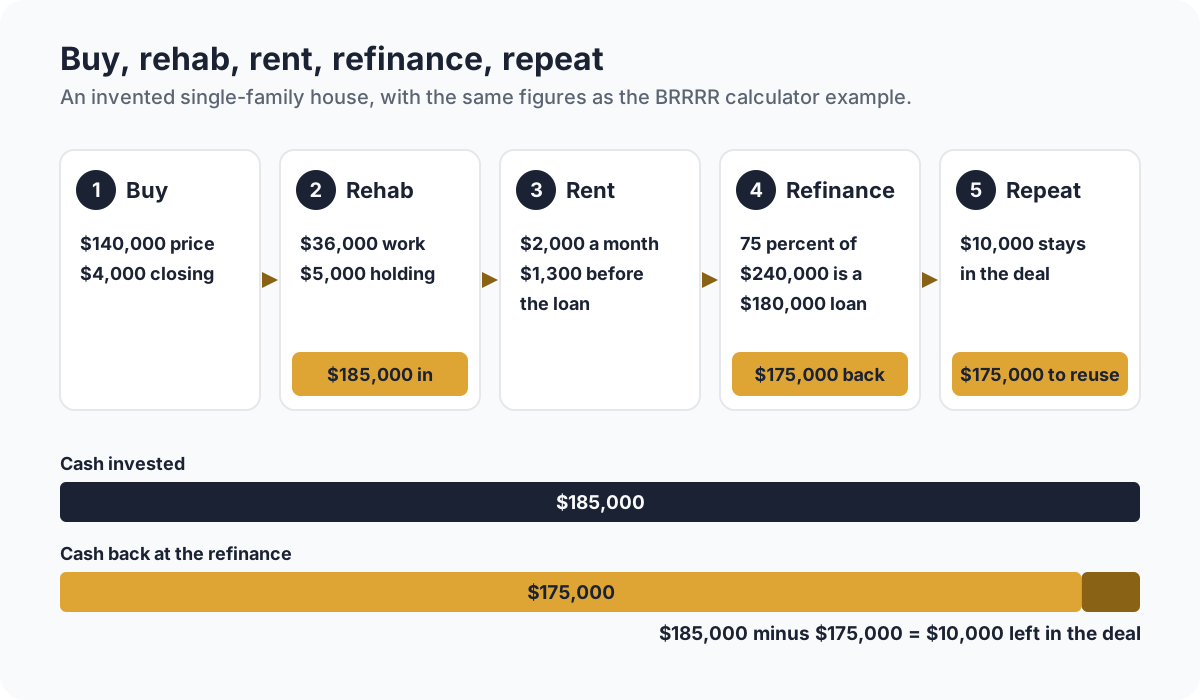
BRRRR stands for buy, rehab, rent, refinance, repeat. A real estate investor buys a property that needs work, fixes it up, rents it out, then refinances at the higher value to take most of the cash back out, and uses that cash on the next property. The figure that tells you how well it worked is the cash left in the deal after the refinance. In the example on this page, $185,000 goes in, the refinance hands $175,000 back, and $10,000 stays in the property.
This page covers what BRRRR is, each of the five steps, a worked example run through the site's calculator, how much cash stays in after a cash-out refinance, the risks that change the result and the mistakes that throw the numbers off. It is general information and is not legal or tax advice. Rules vary by state and city. Check your local law or an attorney.
What is the BRRRR method?
BRRRR is a way to build a portfolio of rentals with the same pool of cash. In a plain purchase, the down payment stays in the property until you sell. In a BRRRR deal, you add value with a rehab, and the refinance lends against that new value. If the new loan is large enough, it repays most of what you spent on the purchase and the work, and the property keeps producing rent.
The measure at the center of it is simple:
Cash left in the deal = cash invested minus cash back at the refinance
Cash invested is everything you pay before the refinance: the price, the closing costs at purchase, the rehab and the holding costs while the work is done. Cash back is the refinance loan minus its closing costs. The smaller the cash left in, the more of your money is free for the next property.
The five steps
- Buy. Find a property priced below what it will be worth once it is fixed up. Many investors pay cash or use a short-term loan for this step, because a property in poor condition can be hard to finance with a standard mortgage. If you use a short-term loan, the refinance pays it off first, so the cash math comes out the same.
- Rehab. Do the work that raises the value: often a kitchen, bathrooms, flooring, paint and any systems that are near the end of their life. The value you plan on after the work is the after repair value, or ARV. The ARV guide shows how to estimate it from recent sales of similar homes nearby.
- Rent. Place a tenant at market rent. A lender on a rental loan usually wants to see a lease, and many look at whether the rent covers the new payment.
- Refinance. Take out a long-term loan against the new value. The lender orders an appraisal and lends a share of it, the loan to value. That loan repays any short-term debt, and what is left after closing costs comes back to you.
- Repeat. Put the cash that came back toward the next property, and run the steps again.
A worked example run through the BRRRR calculator
All the figures here are made up. They are the same figures as the example on the BRRRR calculator page and in the ARV guide, so you can check each step there.
A real estate investor buys a single-family house for $140,000 with $4,000 of closing costs. The rehab costs $36,000, and taxes, insurance and utilities during the work add $5,000 of holding costs. After the work the house appraises at $240,000. The refinance lends 75 percent of that value at 7 percent over 30 years, with $5,000 of closing costs. The house rents for $2,000 a month, with 5 percent vacancy and $600 a month of operating expenses.
| Step | Figure |
|---|---|
| Purchase price | $140,000 |
| Closing costs at purchase | $4,000 |
| Rehab | $36,000 |
| Holding costs | $5,000 |
| Cash invested | $185,000 |
| Appraised value after the work | $240,000 |
| Refinance loan at 75 percent | $180,000 |
| Refinance closing costs | $5,000 |
| Cash back | $175,000 |
| Cash left in the deal | $10,000 |
- Cash invested: $140,000 + $4,000 + $36,000 + $5,000 = $185,000
- Refinance loan: $240,000 x 0.75 = $180,000
- Cash back: $180,000 minus $5,000 = $175,000
- Cash left in the deal: $185,000 minus $175,000 = $10,000
- Share of the cash invested that came back: $175,000 / $185,000 = 94.59 percent
- Equity after the refinance: $240,000 minus $180,000 = $60,000
Then the rent:
- Rent after vacancy: $2,000 x 0.95 = $1,900 a month
- Income before the loan: $1,900 minus $600 = $1,300 a month
- Payment on $180,000 at 7 percent over 30 years: $1,197.54 a month
- Cash flow: $1,300 minus $1,197.54 = $102.46 a month, or $1,229.47 a year
- Cash on cash return: $1,229.47 / $10,000 = 12.29 percent
The cash on cash return guide explains that measure, and the cash on cash return calculator works it out for a property you already own.
How much cash stays in after the refinance
Three numbers decide it: what you spent in total, the appraised value and the share of that value the lender will lend. Many cash-out refinances on rental property lend around 70 to 75 percent of the appraised value, though the share is set by your lender and your loan. To get all of your cash back, the loan after its closing costs has to cover everything you spent.
In the example, a loan of 75 percent leaves $10,000 in. Working backward, to leave nothing in the investor would need $185,000 of cash back, so a loan of $190,000 before the $5,000 of closing costs, and an appraisal of at least $190,000 / 0.75 = $253,333.33. A deal with a modest amount left in can still work, as long as the cash flow and the return on what stays in make sense to you.
Lenders on rental loans also look at the debt service coverage ratio: income before the loan over the loan payments. In the example that is $1,300 / $1,197.54 = 1.09. The DSCR calculator works it out, and your lender sets the ratio it asks for.
The risks that change the result
Each risk below is run through the same calculator, changing one input at a time.
| What changes | Cash left in | Monthly cash flow |
|---|---|---|
| The plan | $10,000 | $102.46 |
| Rehab runs $10,000 over | $20,000 | $102.46 |
| Appraisal comes in at $220,000 | $25,000 | $202.25 |
| Rate is 8 percent | $10,000 | minus $20.78 |
Rehab overruns. Older houses hide problems behind the walls. If the rehab costs $46,000, cash invested rises to $195,000, and with the same $175,000 back, $20,000 stays in. The cash on cash return drops to $1,229.47 / $20,000 = 6.15 percent. Many owners carry a contingency in the rehab budget for this. The CapEx guide covers the larger replacements, such as a roof or a furnace, that tend to drive overruns.
Appraisal shortfall. The lender lends against its own appraisal, which can come in below your ARV. At $220,000, the loan is $220,000 x 0.75 = $165,000, the cash back is $165,000 minus $5,000 = $160,000, and $25,000 stays in. The smaller loan lowers the payment to $1,097.75, so the cash flow rises to $202.25 a month. Planning from the low end of your comparable sales leaves room for this.
Seasoning periods. Many lenders ask you to own a property for a set time before they lend on the new value. Until then, some lend only on what you paid. That waiting period is often called seasoning, and it varies by lender and loan type. While you wait, your cash stays in the property and holding costs keep running. Ask your lender about timing before you count on a refinance date.
Interest rates. The refinance happens months after the purchase, and rates can move in between. At 8 percent, the payment on $180,000 over 30 years is $1,320.78, which is more than the $1,300 of income before the loan, so the cash flow is minus $20.78 a month, or minus $249.31 a year. The cash left in is unchanged, and the property stops paying for itself. Run your numbers at a higher rate than today's before you buy.
Common mistakes
- Leaving out holding and refinance costs. Taxes, insurance, utilities and interest during the work, and the closing costs on the new loan, all add to the cash that stays in.
- Counting on the top of the comparable sales. The appraiser may not see the comps you saw.
- Forgetting the rent has to carry the new loan. A larger refinance means more cash back and a larger payment. Check the cash flow and the DSCR on the loan you plan to take.
- Mixing the rehab costs with other property costs. Keep every invoice and receipt for the work. You need them for the lender, for your records and for your taxes when you sell. The rental property balance sheet keeps the loan and the equity in view after the refinance. How rehab costs are treated on a tax return depends on the work, so ask a tax professional.
Frequently asked questions
What does BRRRR stand for?
Buy, rehab, rent, refinance, repeat. You buy a property that needs work, fix it up, rent it out, refinance at the new value to take cash back out, and use that cash on the next property.
How do you calculate the cash left in a BRRRR deal?
Add the price, the purchase closing costs, the rehab and the holding costs, then subtract the refinance loan minus its closing costs. In the example, $185,000 minus $175,000 leaves $10,000 in the deal.
How much will a lender lend on a BRRRR refinance?
It depends on the lender and the loan. Many cash-out refinances on rental property lend around 70 to 75 percent of the appraised value. Your lender sets the share, the costs and any seasoning period, so check with them before you run your numbers.
What happens if the appraisal comes in low?
The loan is a share of the appraised value, so a lower value means a smaller loan and more of your cash left in. In the example, a $220,000 appraisal leaves $25,000 in, against the $10,000 planned.
Is BRRRR risky?
It has more moving parts than buying a rental in good shape. The rehab can run over, the appraisal can come in low, the lender can ask you to wait, and rates can rise. Run the numbers with a cushion for each.
Track the rehab and the rent in one place
A BRRRR deal is easier to judge when every rehab cost and every rent payment is already filed under its property. In KeyRing, you connect your bank accounts securely through Plaid, and each transaction is matched to a property with suggestions you confirm. Income and expense records use categories you can edit, and you can export your transactions to Excel. See what KeyRing does or how plans are priced.
Free calculators and templates
- BRRRR calculatorCash in, cash back at the refinance and cash left in a buy, rehab, rent, refinance deal.
- Cash on cash return calculatorYearly cash flow as a share of the cash you put in.
- DSCR calculatorHow many times NOI covers the loan payments, and the loan a target ratio allows.
- Rental property balance sheet templateAssets, liabilities and equity for one property at year end, next to last year's.
Browse all rental property calculators, free templates and the glossary.
From the blog
- What is ARV? After repair value for BRRRR investorsARV is what a property should be worth once the repairs are done. How to estimate it from comparable sales, and how it sets a BRRRR refinance, with an example.
- What is a cash-on-cash return? A worked example for a small rental portfolioCash-on-cash return is a year of pre-tax cash flow divided by the cash you put in. The formula, and a worked example for three rentals and the portfolio.
- What is CapEx? Capital expenditures vs repairs on a rentalCapEx is money spent on a rental that lasts for years, such as a new roof. How it differs from a repair, how it is taxed and how to budget a CapEx reserve.