What is a property manager? What one does and when to hire one
By Maya Ellison -

A property manager is a person or company that a property owner hires to run a rental day to day. The manager finds tenants, signs leases as the owner's agent, collects rent, arranges repairs and keeps the records, for fees set out in a written management agreement. The owner still owns the property and makes the big decisions, such as whether to sell, refinance or replace a roof.
This guide covers what a property manager does, how managers charge, a worked example of a year's fees on four units, when hiring one makes sense, what to ask before you sign and how the fees show up on a tax return. It is general information and is not legal or tax advice. Rules vary by state and city. Check your local law or an attorney.
What is a property manager?
A property manager acts for the owner. The lessor vs lessee guide shows how that works on a lease: the owner stays the lessor, and the manager signs as the owner's agent. The management agreement sets out what the manager may decide alone, such as repairs up to a set amount, and what needs the owner's approval.
The term covers a few different arrangements:
- A property management company manages rentals for many owners, with staff for leasing, maintenance and accounting.
- An independent property manager is one person who manages a smaller number of properties.
- An on-site or resident manager lives at or works from a larger building, often as an employee of the owner or of a management company.
- A co-owner or family member may manage the property for the others, with or without a fee.
What a property manager does
| Area | What the manager usually handles |
|---|---|
| Leasing | Sets the asking rent with the owner, advertises the unit, shows it, screens applicants and signs the lease |
| Rent | Collects rent, follows up on late payments and charges the late fees the lease allows |
| Maintenance | Takes repair requests, sends vendors, approves work up to a set limit and handles emergencies |
| Move-in and move-out | Inspects the unit, records its condition and handles the security deposit |
| Records | Keeps the rent ledger, pays bills from the property's funds and sends the owner a statement each month |
| Compliance | Sends required notices, follows local rules and works with an attorney when a dispute goes to court |
Rent and repairs take most of the time. Tenants send repair requests to the manager, often on a maintenance request form, and the manager decides who goes out, keeps the tenant informed and records the cost. At move-in and move-out the manager walks the unit with a move-in checklist and a move-out checklist, so any deposit deduction traces back to a record.
The records are what the owner sees. A manager keeps a rent ledger for each tenant and a rent roll for each property, and sends a monthly owner statement with the rent collected, the bills paid, the fees taken and the money paid out to the owner. On a commercial triple net lease, the manager also bills each tenant for its share of property taxes, insurance and upkeep.
How property managers charge
Every fee belongs in the management agreement. The common ones are:
- Monthly management fee. Usually a percentage of the rent, sometimes a flat amount per unit. Ask whether the percentage applies to rent collected or rent due. A fee on rent collected costs nothing for a month the unit sits empty.
- Leasing or tenant placement fee. Charged when the manager finds a new tenant, often a share of the first month's rent.
- Lease renewal fee. Charged when a tenant renews.
- Setup fee. Charged once when the manager takes on a property.
- Maintenance markup or coordination fee. An amount added to vendor bills, or a charge for overseeing a larger project.
- Other fees. Some agreements charge for inspections, court appearances, collecting unpaid rent or ending the agreement early.
Rates vary by market, by property type and by the services included. Compare written quotes from more than one manager for the same list of services.
A worked example: a year of fees on four units
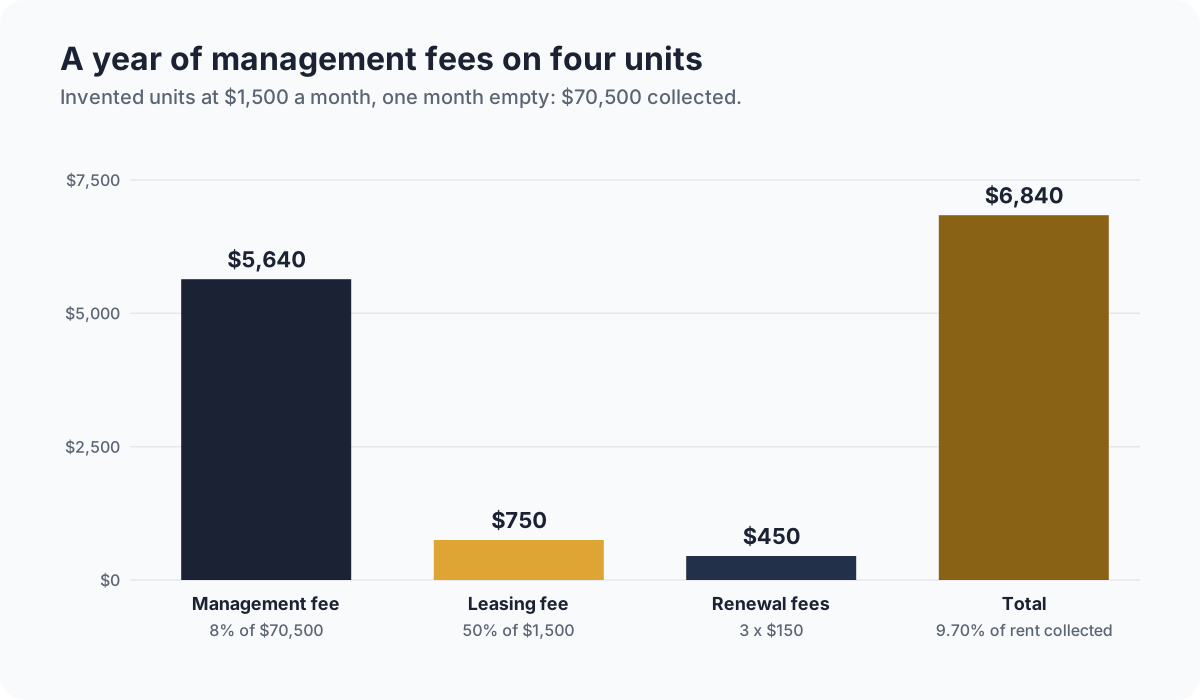
An owner has four invented units that each rent for $1,500 a month. All the figures are made up for this example, including the fees, which are one manager's quote:
- Management fee: 8% of rent collected.
- Leasing fee: 50% of one month's rent for each new tenant.
- Lease renewal fee: $150 per renewal.
During the year one unit turns over and sits empty for one month, and the other three tenants renew.
- Rent due with every unit full all year: 4 x $1,500 x 12 = $72,000.
- Rent collected: $72,000 - $1,500 = $70,500.
- Management fee: 8% x $70,500 = $5,640.
- Leasing fee for the new tenant: 50% x $1,500 = $750.
- Renewal fees: 3 x $150 = $450.
- Total for the year: $5,640 + $750 + $450 = $6,840, which is $6,840 / $70,500 = 9.70% of the rent collected.
If the same 8% applied to rent due, the management fee would be 8% x $72,000 = $5,760, or $120 more, for the month the unit sat empty.
Management is an operating expense, so every fee lowers the property's net operating income. The rental cash flow calculator has a management fee input, so you can see what the property earns with and without one.
When to hire a property manager
Owners usually weigh a few questions:
- Distance. A rental hours away makes showings, inspections and urgent repairs hard to handle in person.
- Number of units. Each unit adds tenants, repairs and records, and the hours add up.
- Time. Managing takes regular hours, plus calls at night and on weekends when something breaks.
- Local knowledge. A manager who works the area knows the rents, the vendors and the local rules.
- The numbers. The fees come out of the property's income, so check that the property still meets your goals with them.
Many owners split the work. Some hire a manager for leasing only and handle the rest themselves; others manage the tenants and hire a bookkeeper for the records.
What to ask before you hire one
- Are you licensed? Many states require a person who manages rentals for other people to hold a real estate broker's license or a property management license. An owner managing their own property usually needs neither. Your state's real estate licensing agency can confirm the rules and look up a license.
- How do you handle rent and deposits? Ask where the money is held, whether it is kept apart from the manager's own funds and on what date you are paid each month.
- What do you charge in total? Get every fee in writing and add them up for a year, as in the example.
- What can you spend without asking me? Agree on a repair limit and on how emergencies are handled.
- What will I see each month? Ask for a sample owner statement and the reports you get at year end.
- How do you choose vendors? Ask whether vendors are licensed and insured, and whether the manager adds a markup to their bills.
- How do I end the agreement? Check the notice period, any fee for ending early and how leases, deposits and records are handed back.
- What insurance do you carry? Ask about general liability and errors and omissions cover, and whether to add the manager to your own policy.
Property management fees on your taxes
For a rental reported on Schedule E, the IRS form has a line for fees paid to a property manager: line 11, Management fees. The Schedule E guide walks through every line, and the IRS Instructions for Schedule E and Publication 527, Residential Rental Property cover rental expenses in detail. Ask a tax professional how to treat one-time fees, such as a leasing fee, for your situation. This section is general information and is not tax advice.
Common mistakes when hiring a property manager
- Comparing the monthly percentage alone. Leasing, renewal and markup fees can add a lot to it. Compare the total for a year.
- No repair limit. Without one, it is unclear which repairs need your approval.
- Unread owner statements. Check each month's statement against the rent roll and the bills.
- Unclear exit terms. Know how to end the agreement before you sign it.
- No copies of your own. Keep copies of leases, ledgers and statements, so a change of manager keeps your history intact.
Frequently asked questions
What does a property manager do?
A property manager runs a rental for its owner: finding and screening tenants, signing leases as the owner's agent, collecting rent, arranging repairs, handling deposits and keeping the records, with a statement to the owner each month.
How much does a property manager cost?
It depends on the fees in the management agreement. Most charge a monthly fee, often a percentage of the rent, plus fees for finding a tenant, renewals and other services. In the example, a year of fees on four units came to $6,840, or 9.70% of the rent collected.
Is a property manager the same as a property owner?
No. The owner owns the property. The manager runs it for the owner under a management agreement and signs leases as the owner's agent, and the owner stays the lessor.
Does a property manager need a license?
In many states, a person who manages rentals for other people needs a real estate broker's license or a property management license. An owner managing their own property usually needs neither. Rules vary by state, so check with your state's real estate licensing agency.
Are property management fees tax deductible?
For a rental reported on Schedule E, fees paid to a property manager go on line 11, Management fees. Ask a tax professional about one-time fees and your own situation. This is not tax advice.
Run your rentals with your team in one place
Whether you manage on your own or with help, it works best when everyone works from the same records. In KeyRing, the owner adds the team, and a property manager handles the day to day on assigned properties: tenants, leases, repairs, rent and expenses. You choose what co-owners and property managers can do across your account, one permission at a time. Tenants pay rent, read the lease and report repairs from the app or any browser. See what KeyRing does or how plans are priced.
Free calculators and templates
- Rent roll templateEvery unit, lease, rent and balance in a property on one page, as of one date.
- Maintenance request formA form tenants fill in to report repairs, and a log to track each one.
Browse all rental property calculators and free templates.