What is rental arbitrage? What property owners should know

Rental arbitrage is when someone leases a home or apartment at a fixed monthly rent and then rents it out short term, by the night or by the room, keeping whatever is left after the rent and the running costs. The property owner collects the same rent every month while the operator carries the booking risk. An operator who leases a one-bedroom for $1,500 a month and books it 60 percent of the year at $140 a night keeps about $3,204 a year, or $267 a month, and breaks even at 52.43 percent occupancy.
This page covers what rental arbitrage is, how it works, what an owner should check before agreeing to it, what to put in writing, a worked example with the operator's numbers and break-even occupancy, and the risks on the owner's side. It is general information and is not legal or tax advice. Rules vary by state and city. Check your local law or an attorney.
What is rental arbitrage?
Rental arbitrage is a business model where the operator does not own the property. They sign a lease with the owner, furnish the unit, list it on a short-term rental platform or rent rooms to separate guests, and earn the gap between what guests pay and what the unit costs to run. The word comes from finance, where arbitrage means buying at one price and selling at a higher one.
On paper it looks like a long-term lease. Inside the unit, a rotating set of guests replaces one household, and local rules, the HOA and the insurance policy may treat that use differently from an ordinary tenancy.
People also call it Airbnb arbitrage or short-term rental arbitrage. Some operators run one unit; others run many under a company.
How rental arbitrage works
- The operator finds a unit that they think will book well at a nightly rate higher than its monthly rent works out to.
- The operator asks the owner for permission to rent the unit short term, and the two sign a lease, usually with an addendum covering short-term use.
- The operator furnishes and lists the unit. They pay for furniture, linens, supplies, utilities, internet and the platform's fees.
- Guests book and stay. The operator handles check-in, cleaning, guest messages and reviews, or pays a co-host or manager to do it.
- The owner collects the monthly rent from the operator, the same as from any tenant, whether the unit was booked that month or not.
What an owner should check before saying yes
A tenant or an operator who proposes rental arbitrage is asking for something most standard leases do not allow. Before you agree, work through these points.
- Written permission. Most residential leases limit subletting and short stays. If you agree, put it in writing, signed by both sides. A verbal yes is hard to prove later and easy to misremember. The sublease guide covers how subletting clauses usually work.
- A lease clause or addendum. Spell out what short-term use is allowed, who is responsible for what and how the arrangement ends. The lease addendum guide explains how an addendum attaches to a lease and what it needs to be valid.
- Local short-term rental rules and permits. Many places require a permit or registration for short-term rentals, collect lodging taxes, cap the number of nights or limit short stays to homes the host lives in. Some apply the rules to the property owner as well as the operator. Check what applies to your property before the first guest arrives.
- Insurance. A standard rental property policy may exclude short-term guests or business use. Ask your insurer in writing whether short-term use is covered, and require the operator to carry liability coverage that names you as an additional insured.
- HOA or condominium rules. Many associations ban or limit short-term rentals, and fines usually go to the unit owner. Read the governing documents and ask the association if anything is unclear.
- Your mortgage. Some loans limit how the property is used. Read the loan terms.
- The operator. Ask for references, a track record and proof of the company's standing. If the lease is with a company, a personal guarantee from its owner works much like a co-signer on a residential lease.
If any of these points comes back as a firm no, the answer to the operator is no, however good the rent looks.
What to put in the addendum
Have an attorney draft or review the language. Owners commonly cover:
- Permitted use. Short-term stays allowed, maximum guests per stay, and any minimum stay length.
- Compliance. The operator gets and keeps any required permits or registrations, collects and pays any lodging taxes, and follows HOA rules, with copies sent to you.
- Insurance. Required coverage amounts, you named as additional insured, and proof of coverage at signing and each renewal.
- Fines and damage. The operator pays any fine, fee or damage that comes from the short-term use.
- Deposit. A larger security deposit to reflect the extra wear, where local law allows it.
- Access and inspections. Notice periods for your inspections and how often you can make them.
- Ending the arrangement. What happens if a rule changes, a permit is refused or the HOA objects, and how bookings already made are handled.
A worked example: a one-bedroom
All the figures here are made up. An operator offers to lease a one-bedroom apartment for $1,500 a month on a one-year lease and run it as a short-term rental. The operator's plan:
- Nightly rate: $140
- Occupancy: 60 percent of the year, so 365 x 0.60 = 219 booked nights
- Average stay: 3 nights, so 219 / 3 = 73 stays
- Cleaning fee guests pay: $60 a stay. Cleaning cost the operator pays: $60 a stay.
- Booking fees: 15 percent of what guests pay
- Running costs: $350 a month for utilities, internet, supplies and insurance
The operator's year, run through the site's Airbnb calculator with the monthly rent entered as the mortgage payment:
| Line | Amount |
|---|---|
| Nightly revenue, 219 x $140 | $30,660 |
| Cleaning fees from guests, 73 x $60 | $4,380 |
| Gross revenue | $35,040 |
| Booking fees, 15 percent of $35,040 | $5,256 |
| Cleaning costs, 73 x $60 | $4,380 |
| Running costs, $350 x 12 | $4,200 |
| Net operating income | $21,204 |
| Rent paid to the owner, $1,500 x 12 | $18,000 |
| Operator's margin | $3,204 |
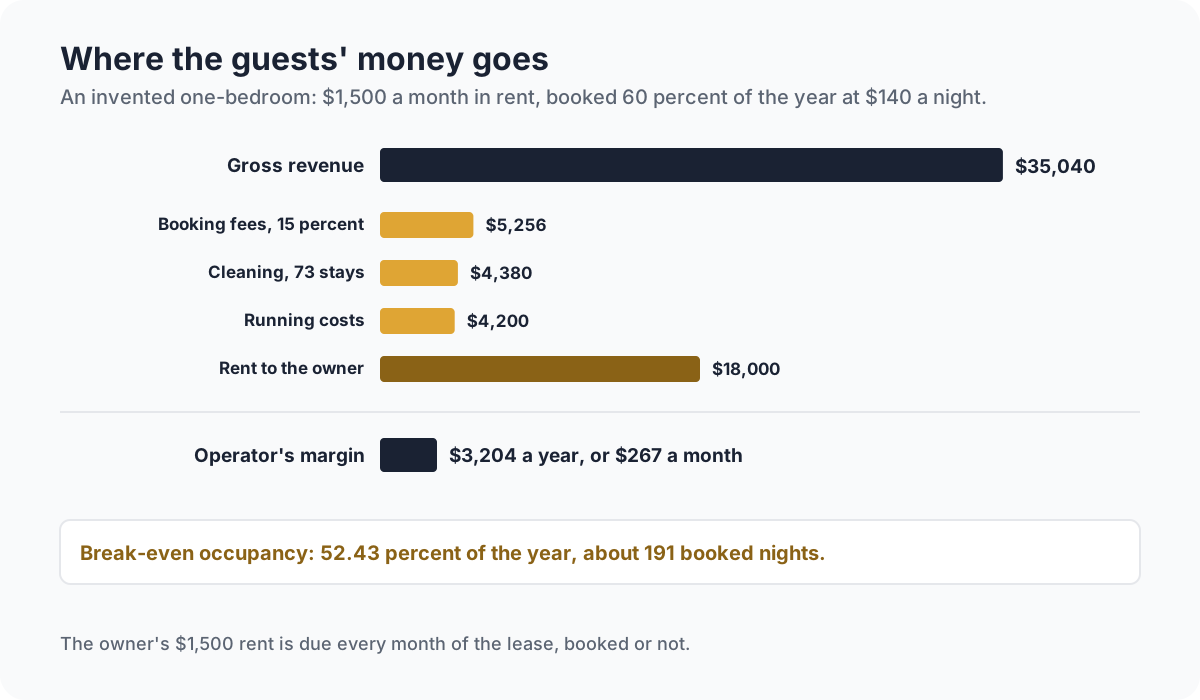
The margin is $35,040 minus $5,256, $4,380, $4,200 and $18,000, which is $3,204 a year, or $3,204 / 12 = $267 a month. The owner receives $18,000 across the year, the same as from any one-year lease at that rent. The operator's furniture and setup costs come on top.
Break-even occupancy
Break-even occupancy is the share of the year the unit must be booked for the operator to cover the rent and running costs. Each booked night adds $140 x 0.85 = $119 after booking fees. The cleaning fee does not quite cover itself: $60 x 0.85 = $51 kept against a $60 cost loses $9 a stay, or $3 a night across a 3-night stay. So each booked night adds $116.
The fixed costs are $4,200 of running costs plus $18,000 of rent, $22,200 a year. $22,200 / $116 = 191.38 nights, and 191.38 / 365 = 52.43 percent.
Below that level the operator loses money, and the rent to the owner is still due. An operator whose plan needs high occupancy has little room for a slow season, a new local rule or poor reviews, so the figure matters to the owner too.
The owner's side of the numbers
From the owner's seat, rental arbitrage is a long-term lease with a different kind of tenant. The rent is fixed, and the property's operating expenses mostly stay where they were, though wear, repairs and turnover may rise with more guests. Run the property through the rental cash flow calculator at the rent the operator offers and at an ordinary market rent, and compare. Some owners ask for a higher rent, or a share of booking revenue on top of a base rent. Either can work if it is written down and the operator's plan still clears break-even.
Rental arbitrage compared with subleasing and house hacking
Rental arbitrage is a form of subletting, run as a business with many short stays a year. House hacking is a different idea: an owner buys a property, lives in part of it and rents the rest out. The house hacker owns the home, while the arbitrage operator only leases it.
Frequently asked questions
Is rental arbitrage legal?
It depends on the lease, the local short-term rental rules, the HOA and the insurance policy. Where short-term rentals are allowed and the owner gives written permission, it can be a lawful business. Without permission, it is usually a lease violation. Rules vary by state and city. Check your local law or an attorney.
Should a property owner allow rental arbitrage?
That is the owner's decision. Agree only after checking the local rules, the HOA, the insurance policy and the mortgage, and only with a written addendum covering permits, insurance, fines, damage and how the arrangement ends.
How does the operator make money?
They collect more from guests than the unit costs to run. In the example, $35,040 of gross revenue minus booking fees, cleaning, running costs and $18,000 of rent leaves the operator $3,204 a year, or $267 a month.
What is break-even occupancy in rental arbitrage?
It is the share of the year the unit must be booked to cover the rent and running costs. In the example, each booked night adds $116 after fees and cleaning, and $22,200 of fixed costs needs 191.38 nights, which is 52.43 percent of the year.
What if a tenant is already renting the unit short term without permission?
Read the lease and the HOA rules, document what you find, and talk to an attorney before you act, since rules on notices and lease violations vary.
Keep the operator's lease and rent on record
A rental arbitrage lease is easier to manage when its rent and documents are in one place. In KeyRing, each lease keeps its rent charges, payments and balance, you can record cash and check payments, including partial ones, and overdue invoices are flagged automatically. Each month's rent invoices are drafted for you to approve before they are sent, and each tenant gets a PDF invoice by email. See what KeyRing does or how plans are priced.
Free calculators and templates
- Airbnb calculatorA short-term rental's yearly revenue, costs, cash flow and break-even occupancy.
- Rental cash flow calculatorMonthly cash flow line by line, per unit, with the break-even rent.
Browse all rental property calculators, free templates and the glossary.
From the blog
- What is a sublease? What property owners should put in writingA sublease is a tenant renting their home to someone else for part of the lease. How it differs from an assignment, who owes the rent and what goes in writing.
- What is a lease addendum? Common addenda and how to add oneA lease addendum adds new terms to a signed lease, such as a pet or a parking space. How it differs from an amendment, common addenda and how to add one.
- What is house hacking? How it works with a duplex or a spare roomHouse hacking means living in part of a property and renting out the rest. How it works with a duplex or spare rooms, the loans, the math and the trade-offs.