What is a multifamily property? Types, numbers and upkeep

A multifamily property is a residential property with two or more separate homes in one building or on one lot, each with its own kitchen, bathroom and entrance. It runs from a duplex up to an apartment complex with hundreds of units. Investors judge one mostly on the rent it brings in after its running costs. In the example on this page, a six-unit building bought for $720,000 earns $47,313.60 of net operating income a year, a cap rate of 6.57 percent.
This page covers what counts as multifamily, how small buildings differ from buildings of five units or more, living in one unit while renting the rest, the numbers investors check, a worked six-unit example and the work a multi-unit building brings. It is general information and is not legal or tax advice. Rules vary by state and city. Check your local law or an attorney.
What is a multifamily property?
A multifamily property, also called a multi-unit or multi-dwelling property, holds more than one household under separate leases. The units share a building, a lot or both, and they usually share a roof, a foundation, a driveway and some of the utility lines. A single-family home, by comparison, has one household on one lot.
Common types include:
- Duplex, triplex and fourplex. Two, three or four units in one building. The duplex guide compares them side by side and explains how they differ from a twin home or a condo.
- Garden-style and walk-up apartments. Low buildings, often two or three stories, with stairs and outdoor space and no elevator.
- Mid-rise and high-rise buildings. Larger buildings with elevators, shared lobbies and often on-site staff.
- Mixed-use buildings. Apartments above shops or offices. Lenders and local rules may treat these differently from purely residential buildings.
- Several houses on one lot. A main house with a cottage behind it, under one owner.
A condo building also holds many households, but each unit there usually has its own owner. A multifamily property in the investing sense has one owner for all of its units.
Small multifamily and buildings of five units or more
Owners and lenders often split multifamily into two groups.
Small multifamily: two to four units. Lenders generally treat these like houses, so they can often be bought with a residential mortgage. Their value tends to follow nearby sales of similar buildings. Terms, down payments and how much expected rent counts toward qualifying vary by lender and loan program, so ask a lender early.
Five units or more. These are usually financed with a commercial loan. The lender looks closely at the building's income, often using a debt service coverage ratio, and the value is driven more by the income the building produces.
The line at five units is a common rule of thumb in lending, and local rules can draw other lines for building codes, inspections or rent rules. Check what applies where the building sits.
Living in one unit: house hacking
Buying a small multifamily building, living in one unit and renting out the others is called house hacking. The rent from the other units goes toward the mortgage, taxes and insurance, and when you move out later your unit becomes one more rental. Owner-occupied loans for two to four units sometimes come with a smaller down payment than an investment property loan, with a requirement to live there for a set time. The house hacking guide covers it in full, and the house hacking calculator works out what living there would cost you each month.
How investors judge a multifamily property
These are the figures most buyers ask for first.
- Rent roll. A list of every unit with its tenant, rent, lease dates, deposit and balance. It shows what the building actually collects today. The rent roll guide explains how to read one, and the rent roll template lays one out.
- Vacancy. The share of rent lost to empty units. More units spread the risk: one empty unit in a six-unit building costs a sixth of the rent, where one empty house costs all of it. The vacancy rate calculator works it out from your own records.
- Net operating income (NOI). Rent collected, plus other income such as laundry or parking, minus the operating expenses. The mortgage is left out. The NOI guide and the NOI calculator cover it in detail.
- Cap rate. NOI divided by the price. It lets you compare buildings of different sizes on the same footing. The cap rate guide and the cap rate calculator show how it is used.
- Price per unit. The price divided by the number of units. It is a quick way to compare buildings in the same area, though it ignores unit size and condition.
- Gross rent multiplier (GRM). The price divided by a year of scheduled rent, before vacancy and expenses. A lower number means more rent for each dollar of price. The gross rent multiplier calculator runs it for any listing.
Price per unit and GRM are quick screens for sorting listings. NOI and cap rate need real expense figures, which is why a buyer asks for the seller's records.
A worked example: a six-unit building
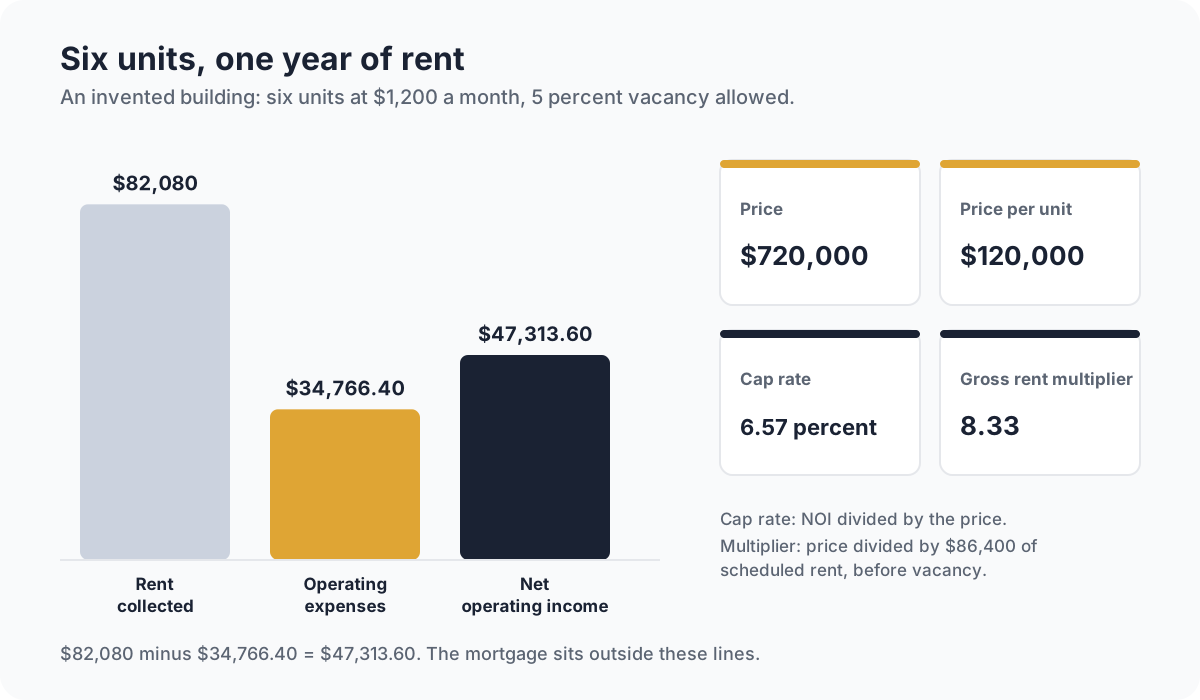
All the figures here are made up. A real estate investor looks at a six-unit building listed at $720,000. Every unit rents for $1,200 a month, and the owner pays water, sewer and trash for the whole building.
- Price per unit: $720,000 / 6 = $120,000
- Gross potential rent: 6 x $1,200 x 12 = $86,400 a year
- Vacancy allowance of 5 percent: $86,400 x 0.05 = $4,320
- Rent collected: $86,400 minus $4,320 = $82,080
The operating expenses for the year:
| Expense | Amount |
|---|---|
| Property taxes | $9,000 |
| Management, 8 percent of rent collected | $6,566.40 |
| Repairs and maintenance | $5,400 |
| Water, sewer and trash | $4,800 |
| Insurance | $3,600 |
| Turnover cleaning and painting | $2,400 |
| Landscaping and snow removal | $1,800 |
| Common-area electricity | $1,200 |
| Total operating expenses | $34,766.40 |
- Net operating income: $82,080 minus $34,766.40 = $47,313.60, or $7,885.60 per unit
- Cap rate: $47,313.60 / $720,000 = 6.57 percent
- Gross rent multiplier: $720,000 / $86,400 = 8.33
- Operating expense ratio: $34,766.40 / $82,080 = 42.36 percent
The NOI calculator, the cap rate calculator and the gross rent multiplier calculator return the same figures from these inputs.
Because a building of this size is often valued on its income, the cap rate works in both directions. If similar buildings nearby sell at a 7 percent cap rate, the same NOI points to a value of $47,313.60 / 0.07 = $675,908.57, below the asking price. If the owner could add $3,000 a year of laundry income without new costs, NOI would rise to $50,313.60, and at the same 7 percent the value would rise by about $42,857.
The rental property calculator adds the mortgage to these figures to show cash flow, and the rental yield calculator shows gross and net yield on the price.
The work a multifamily property brings
More units under one roof means more rent from one purchase, and it also means more people, systems and shared space to look after.
- Shared utilities. Older buildings often have one water meter, and sometimes one gas or electric meter, for everyone. The owner pays that bill and recovers it through the rent or, where local rules allow, through a utility charge.
- Common areas. Hallways, stairs, laundry rooms, parking lots, yards and trash areas are the owner's job: cleaning, lighting, snow removal and repairs.
- Turnover. With six units, some move-outs happen almost every year. Each one brings cleaning, painting, repairs, advertising and a gap in rent. Planning for steady turnover, with a budget line for it, keeps one move-out from upsetting the year.
- Shared systems. A roof, a boiler or a sewer line serves the whole building, and a failure affects everyone. Set money aside for these large replacements.
- Neighbors. Tenants share walls, parking and noise. Clear house rules in each lease prevent many disputes.
- Local rules. Larger buildings may face rental registration, inspections, fire code requirements and rent rules that do not apply to a single house. Check the city and state rules before you buy.
Many owners of larger buildings hire a property manager. Even if you manage it yourself, include a management cost when you compare deals, since a lender or a future buyer will count one.
Frequently asked questions
How many units make a property multifamily?
Two or more separate homes in one building or on one lot. A duplex is the smallest multifamily property. The split many lenders use is between buildings of two to four units and buildings of five units or more.
Is a multifamily property a good first investment?
It can be, especially a small building you live in while renting the other units. It also brings more tenants, more shared costs and more to manage than a single house. Run the numbers on the building in front of you, with a cushion for vacancy and repairs.
How is a multifamily property valued?
Buildings of two to four units are often valued by comparing them with nearby sales of similar buildings. Buildings of five units or more are valued more on their income, usually NOI divided by a market cap rate. In the example, $47,313.60 of NOI at a 7 percent cap rate points to $675,908.57.
What is a good cap rate for a multifamily property?
There is no single right figure. Cap rates vary with the market, the building's age and condition, the interest rate climate and the risk a buyer sees. Compare a building with recent sales of similar buildings in the same area.
Who pays the utilities in a multifamily building?
It depends on the meters and the leases. Where each unit has its own meter, tenants usually pay their own. Where units share a meter, the owner usually pays and recovers the cost through the rent or a utility charge where local rules allow it.
Keep every unit's income and costs in one place
A multifamily building is easier to judge when every rent payment and every shared bill is already filed under its property. In KeyRing, you connect your bank accounts securely through Plaid, and each transaction is matched to a property with suggestions you confirm. Income and expense records use categories you can edit, and you can export your transactions to Excel. See what KeyRing does or how plans are priced.
Free calculators and templates
- Gross rent multiplier calculatorPrice over a year of gross rent, and the price your target GRM supports.
- House hacking calculatorWhat living in your own rental costs you each month after the other units' rent.
- Rental yield calculatorGross and net yield: a year of rent as a share of the price.
- Rental property calculatorCash flow, cap rate, cash on cash return and ROI for one property, all at once.
- Rent tracker templateEvery unit on one row and every month in a column, so a year of rent fits on one page.
Browse all rental property calculators, free templates and the glossary.
From the blog
- What is a duplex? Duplex, triplex and fourplex for real estate investorsWhat a duplex, triplex and fourplex are, how they differ from a twin home or a condo, how they are financed and how to compare their numbers.
- What is house hacking? How it works with a duplex or a spare roomHouse hacking means living in part of a property and renting out the rest. How it works with a duplex or spare rooms, the loans, the math and the trade-offs.
- What is a rent roll (with a free template)A rent roll lists each unit, tenant, lease and rent in a property as of one date. See what it includes, a fourplex example and the numbers you can pull from it.