What is a duplex? Duplex, triplex and fourplex for real estate investors
By Maya Ellison -

A duplex is one building on one lot that holds two separate homes, each with its own entrance, kitchen and bathroom. A triplex holds three homes and a fourplex holds four. Real estate investors like these small multi-unit buildings because one purchase brings in more than one rent, and many buyers start out by living in one unit while the others pay part of the bills.
This guide covers what each type is, how they compare with a twin home or a condo, how financing usually works, the numbers to check before you buy and a side-by-side example of a duplex, a triplex and a fourplex.
What is a duplex?
A duplex is a single residential building with two dwelling units. Each unit is a complete home with its own front door, kitchen, bathroom and usually its own utility meters. The two units share the structure and the lot, and one owner holds the whole property on one deed.
The units sit in one of two layouts:
- Side by side. The two homes share a center wall, often mirror images of each other, each with its own front door and yard.
- Up and down. One home is on the ground floor and the other is above it, with separate entrances, often a front door and a side or back stair.
A duplex is zoned and sold as one property. When you buy it, you buy both units, and you collect rent from every unit you lease out.
Duplex, triplex and fourplex
The names follow the number of units:
- Duplex: 2 units in one building.
- Triplex: 3 units, often stacked one per floor or arranged side by side.
- Fourplex: 4 units, often two up and two down. You will also see it called a quadplex or a four-family home.
Buildings with five units or more are usually called apartment buildings or multifamily properties, and lenders treat them differently, as the financing section explains.
Duplex vs twin home vs condo
Some properties look like a duplex from the street and are owned another way:
- A twin home (also called a semi-detached house) is two homes sharing a wall, each on its own lot with its own deed. You can buy one half by itself.
- A condo is one unit in a building where each unit has its own owner and an association looks after the shared parts.
- A duplex is the whole building with both units on one deed, so one owner controls both.
Check the deed and the county records before you make an offer. A listing that says "duplex" can turn out to be one half of a twin home, which brings one rent.
How financing a duplex, triplex or fourplex usually works
Lenders generally treat buildings of one to four units as residential property, so a duplex, triplex or fourplex can usually be bought with a residential mortgage. Five units or more usually need a commercial loan, which is priced and underwritten on the building's income.
If you plan to live in one unit, many owner-occupied loan programs accept two to four units, often with a smaller down payment than an investment property loan. These loans usually ask you to move in within a set time and live there for a period, often at least a year. Lenders differ on how much of the expected rent counts toward qualifying, so ask yours early and bring the current leases or a rent estimate for each unit.
House hacking with a small multi-unit
Living in one unit and renting out the rest is called house hacking, and the house hacking guide covers it in full, spare rooms included. The rent from the other units goes toward the mortgage, taxes and insurance, and when you move out later, your unit becomes one more rental.
The house hacking calculator works this out for a $360,000 duplex with 5% down: the costs come to $3,125.33 a month and the other unit brings $1,710 after a 5% vacancy allowance, so living there costs $1,415.33 a month. A triplex or a fourplex spreads the same idea across more units. In the fourplex below, living in a $1,450 unit leaves $6,400 - $1,450 = $4,950 a month of rent from the other three.
Numbers to check before you buy
Small multi-units are often compared on a few quick ratios before anyone builds a full budget:
- Rent per unit and in total. List each unit's current rent and what it would rent for today. A rent roll puts every unit, lease and balance on one page, and a seller should be able to give you one.
- Gross rent multiplier. Price divided by a year of gross rent. A lower number means more rent for each dollar of price. The gross rent multiplier calculator runs it for any price and rent.
- Gross and net yield. A year of rent as a share of the price, before and after operating costs. The rental yield calculator shows both.
- Who pays which utilities. Separate meters let each tenant pay their own. A shared meter means the owner usually pays, and that cost belongs in your budget.
- Condition of shared parts. Roof, foundation, heating and water heaters serve more than one home, so a repair costs more and touches more tenants. Walk every unit with the rental inspection checklist so each one gets the same room by room check.
A duplex, triplex and fourplex compared
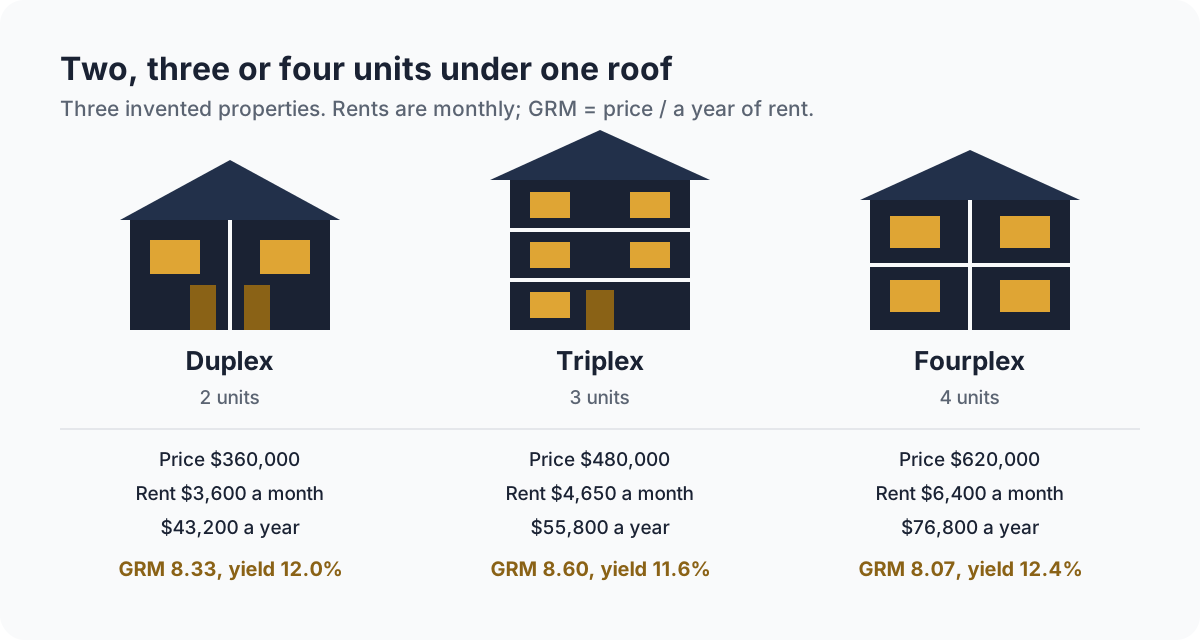
Here are three invented properties on the same street, with gross rent multiplier (GRM) and gross yield worked out from the price and a year of rent:
| Property | Units | Price | Rent a month | Rent a year | GRM | Gross yield |
|---|---|---|---|---|---|---|
| Duplex | 2 | $360,000 | $3,600 | $43,200 | 8.33 | 12.0% |
| Triplex | 3 | $480,000 | $4,650 | $55,800 | 8.60 | 11.6% |
| Fourplex | 4 | $620,000 | $6,400 | $76,800 | 8.07 | 12.4% |
The arithmetic for each:
- Duplex: 2 x $1,800 = $3,600 a month, or $43,200 a year. GRM is $360,000 / $43,200 = 8.33, and gross yield is $43,200 / $360,000 = 12.0%.
- Triplex: 3 x $1,550 = $4,650 a month, or $55,800 a year. GRM is $480,000 / $55,800 = 8.60, and gross yield is $55,800 / $480,000 = 11.6%.
- Fourplex: $1,450 + $1,450 + $1,750 + $1,750 = $6,400 a month, or $76,800 a year. GRM is $620,000 / $76,800 = 8.07, and gross yield is $76,800 / $620,000 = 12.4%.
On these numbers the fourplex brings the most rent for each dollar of price, and the triplex the least. Price per unit tells a similar story: $180,000 for the duplex, $160,000 for the triplex and $155,000 for the fourplex. Gross figures leave out vacancy and operating costs, so treat them as a first screen and check net yield and cash flow before you decide.
Pros and cons of a small multi-unit
- More than one rent from one purchase. One loan, one roof and one closing bring in two to four rents.
- Vacancy hurts less. With four units, one empty unit takes away a quarter of the rent. In a single-family rental, it takes all of it.
- Residential financing. Up to four units, you can usually use the same kinds of loans as a house.
- Shared systems cost more to fix. A new roof or boiler serves every unit at once.
- More tenants to manage. Each unit has its own lease, rent, deposit and move-in and move-out.
- Smaller pool of buyers when you sell compared with single-family homes in many areas.
Frequently asked questions
What is a duplex?
A duplex is one building with two separate homes, each with its own entrance, kitchen and bathroom. The two units share the structure and the lot, and the whole property sits on one deed.
What is the difference between a duplex, a triplex and a fourplex?
The number of units. A duplex has two, a triplex has three and a fourplex has four. All three are usually financed as residential property.
Is a duplex a good first investment property?
It often is for buyers who plan to live in one unit, because the other rent helps with the mortgage and owner-occupied loans can need a smaller down payment. Run the numbers first: the house hacking calculator shows what living there would cost you each month.
What is the difference between a duplex and a twin home?
A duplex is one property with both units on one deed. A twin home is two homes that share a wall, each on its own lot and deed, so each half can be sold on its own.
How many units can a residential mortgage cover?
Lenders generally treat one to four units as residential property. Five units or more usually need a commercial loan.
Keep every unit's lease and rent in one place
A duplex has two leases, a fourplex four, and each one has its own rent, deposit and dates. In KeyRing, you create a lease for each unit, tenants pay rent and file maintenance requests with photos on the web, and the occupancy report shows which units are leased. Each property can sit under the company that owns it, and plans are priced by units. See what KeyRing does or how plans are priced.
Free calculators and templates
- Rental yield calculatorGross and net yield: a year of rent as a share of the price.
- Gross rent multiplier calculatorPrice over a year of gross rent, and the price your target GRM supports.
- House hacking calculatorWhat living in your own rental costs you each month after the other units' rent.
- Rental inspection checklistA room by room check of an occupied rental, with the repairs it turns up.