What is a rental application? What it asks and what owners check

A rental application is the form a prospective tenant fills in to apply for a home. It collects the facts an owner needs to decide who to rent to: who the applicant is, what they earn, where they work, where they have lived and who can speak for them. It also usually gives the owner written permission to check those facts. In the worked example below, a couple earning $52,800 a year applies for a $1,400 home, and their rent comes to 31.8 percent of their gross monthly income.
This page covers what a rental application is, what it usually asks, how application fees work, why every applicant should be held to the same written criteria, what owners usually verify, a worked income check, how long applications are kept and the mistakes that cause trouble. It is general information and is not legal or tax advice. Rules vary by state and city. Check your local law or an attorney.
What is a rental application?
A rental application is the first formal step between a prospective tenant and a property owner. The applicant fills in the form, signs it and usually pays an application fee. The owner reviews it against the standards set for the property and then approves the applicant, asks for more, such as a co-signer, or declines.
An application is a request to rent. It does not create a tenancy on its own, and neither side is bound to a lease until a lease is signed. Many owners ask every adult who will live in the home to fill in a separate application, since each adult usually signs the lease and shares responsibility for the rent.
What a rental application usually asks
Most applications cover the same ground:
- Identity. Full legal name, date of birth, contact details and a form of identification.
- Income. Gross income and its sources, often with pay stubs, tax returns, bank statements or an offer letter as proof.
- Employment. The current employer, job title, start date and a contact who can confirm the job.
- Rental history. Current and past addresses, the rent paid at each, the dates and contact details for each past owner or manager.
- References. One or two personal or professional references.
- Occupants and pets. Who will live in the home and any pets the applicant plans to keep.
- Permission to check. A signed consent that lets the owner verify what the form says and, where the owner uses them, run checks such as a credit or background report.
An application that asks about pets should keep in mind that assistance animals for people with disabilities are generally treated differently from pets, so pet rules, pet rent, pet deposits and pet fees usually do not apply to them. The entry on a pet addendum covers how pet terms are usually written into a lease.
Application fees
Many owners charge a fee with each application to cover the cost of reviewing it and running any reports. Some places cap application fees, limit them to the actual cost of screening, require a receipt or an itemized list of costs, or require a refund when no report was run. Some places bar the fee entirely in certain cases. Check the rule where the property is before you set a fee, and charge it the same way to every applicant.
Use the same written criteria for every applicant
Fair housing laws generally bar treating applicants differently because of protected traits such as race, color, religion, sex, national origin, disability or family status, and many places protect more traits, such as source of income. The safest habit is to write the rental criteria down before you advertise the home and then apply them the same way to every applicant. Typical written criteria cover a minimum income, a rental history standard and how any reports are weighed.
Review complete applications in the order they arrive and keep notes on why each one was approved or declined. If an applicant falls short of one standard, decide in advance which options you offer to everyone, such as a co-signer or a guarantor. The guide to renting to tenants with bad credit walks through those options in more depth.
What owners usually verify
An application is only as good as the facts behind it, so many owners confirm the main points:
- Income and employment. Pay stubs or a call to the employer, checked against the income on the form.
- Rental history. A short form or call to a past owner, covered in the entry on rental verification.
- Identity. A check that the identification matches the name on the form.
- Reports. Where the owner uses them and the applicant has consented, a credit or background report, weighed under the written criteria.
Ask each applicant for the same kinds of proof and verify each one the same way.
A worked example: an income check and two application fees
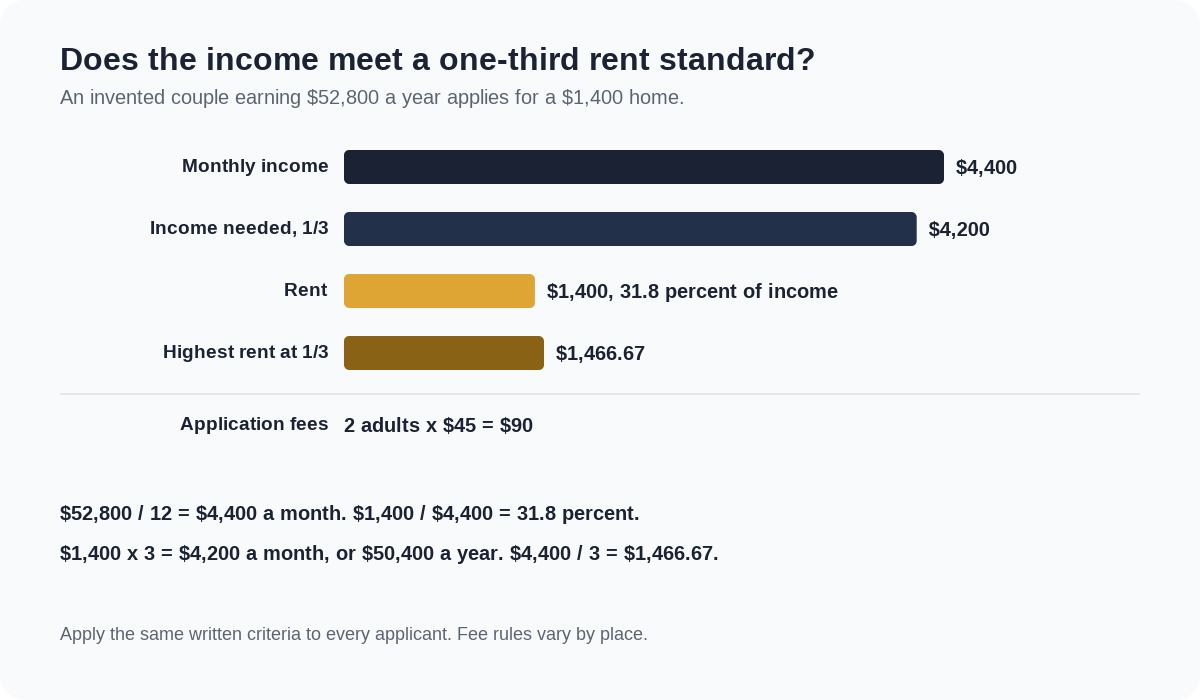
All the figures here are made up. Two adults apply together for a home that rents for $1,400 a month. One earns $30,000 a year and the other earns $22,800, for a combined gross income of $52,800 a year. The owner's written criteria say rent should be no more than one third of gross monthly income, and the application fee is $45 for each adult.
Using the site's rent to income ratio calculator:
- Gross monthly income: $52,800 / 12 = $4,400
- Rent to income ratio: $1,400 / $4,400 = 31.8 percent, so income is 3.14 times the rent
- Income needed at one third: $1,400 x 3 = $4,200 a month, or $50,400 a year
- Highest rent at one third of this income: $4,400 / 3 = $1,466.67
- Application fees: 2 x $45 = $90
The couple clears the standard by $200 a month. The owner then confirms both incomes with pay stubs and checks their rental history with their current owner, in the same order and the same way as for every other applicant. Once they are approved and sign the lease, the security deposit and first month's rent are usually due before move-in.
How long to keep rental applications
Keep each application, the proof that came with it and your notes on the decision, for approved and declined applicants alike. Many owners keep them for a few years, since the records show that each applicant was held to the same criteria if a decision is questioned later. Some places set how long certain records must be kept and how they must be stored and destroyed. Store applications securely, since they hold personal and financial details, and check the local rule on how long to keep them.
Mistakes that cause trouble
- No written criteria. Deciding case by case makes it hard to show every applicant was treated the same way.
- Taking a fee you cannot justify. A fee above a local cap, or with no report run, can lead to a refund or a complaint.
- Asking questions the law bars. Questions about protected traits have no place on the form.
- Skipping verification. Approving on the form alone leaves income and rental history unconfirmed.
- Loose storage. Paper applications in an open file or emailed scans in a shared inbox put applicants' personal data at risk.
Frequently asked questions
What does a rental application ask for?
Most ask for identity, income, employment, rental history, references, who will live in the home and any pets, plus signed permission for the owner to verify the details. Many owners ask each adult occupant for a separate application.
How much does a rental application fee cost?
It varies. Many owners charge a fee to cover the cost of reviewing the application and running reports. Some places cap the fee, limit it to the actual cost of screening or require a refund in certain cases, so check the local rule before you set one.
Can an owner decline a rental application?
Yes, for reasons based on written criteria applied the same way to every applicant, such as income or rental history. Declining an applicant because of a protected trait is generally illegal. Some places require the owner to tell the applicant the reason in writing.
What if an applicant earns less than the income standard?
Many owners offer the same options to everyone who falls short, such as a co-signer, a guarantor or a larger deposit where the local rules allow it. In the example, a couple earning $52,800 a year meets a one-third standard for $1,400 rent, since one third needs $4,200 a month.
How long should an owner keep rental applications?
Many owners keep applications, proof and decision notes for a few years, for approved and declined applicants alike. Some places set a minimum, so check the local rule, and store the records securely.
Keep each applicant's application with their record
Applications are easier to review fairly when they sit in one place. KeyRing tracks prospective tenants by property, emails them your application form and keeps the completed application with their record. Once the lease starts, each lease keeps its rent charges, payments and balance, you can record cash and check payments, including partial ones, and overdue invoices are flagged automatically. See what KeyRing does or how plans are priced.
Free calculators and templates
Browse all rental property calculators, free templates and the glossary.
From the blog
- Renting to tenants with bad credit: how property owners weigh the riskHow to weigh an applicant with bad credit: what the report shows, income and rental history, co-signers and deposits, fair housing and a worked example.
- What is a guarantor? Guarantor vs co-signer on a leaseA guarantor promises to pay the rent if the tenant does not. How a guarantor differs from a co-signer, who usually qualifies and what a guaranty covers.