What is cost segregation? Faster depreciation for rental property

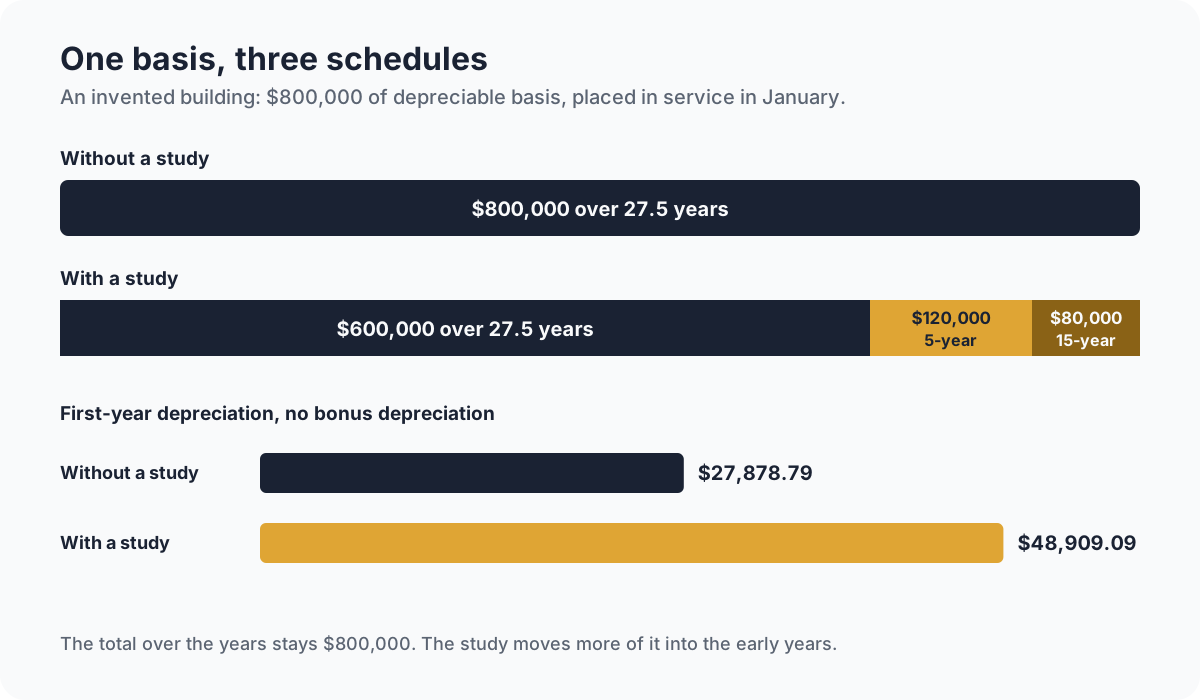
Cost segregation is a study that splits the cost of a rental building into parts with shorter tax lives. In the United States, a residential rental building is depreciated over 27.5 years, but items inside and around it, such as appliances, carpet and paving, can qualify for 5-year or 15-year schedules. Moving cost to those shorter schedules brings more depreciation into the early years of ownership. In the example on this page, a study raises the first year's depreciation on an $800,000 basis from $27,878.79 to $48,909.09.
This page covers what cost segregation is, how a study works, a worked example run through the site's calculator, what bonus depreciation does to the numbers, depreciation recapture when you sell and when a study tends to make sense. It is general information and is not legal or tax advice. Rules vary by state and city. Check your local law or an attorney. Ask a tax professional before you act on a study.
What is cost segregation?
When you buy a rental property, the price is split between the land, which is never depreciated, and the building, which is depreciated over its recovery period. Under the federal tax rules, a residential rental building is 27.5-year property and a commercial building is 39-year property. Each year you deduct a slice of the building's cost on your tax return, usually on Schedule E for an individual owner. The Schedule E guide covers where depreciation goes on the form.
A building is made of many parts, and the tax rules give some of them shorter lives:
| Recovery period | Typical items in a rental |
|---|---|
| 5 years | Appliances, carpet, furniture, some cabinets and fixtures that serve the units |
| 15 years | Land improvements: paving, driveways, sidewalks, fences, landscaping, outdoor lighting |
| 27.5 years | The residential building itself: structure, roof, walls, plumbing, wiring |
| 39 years | A commercial building |
A cost segregation study identifies those shorter-life parts and assigns part of the purchase price to each. The total depreciation over the life of the property stays the same. The study changes when it arrives.
How a study works
Studies are usually done by firms with engineers or cost estimators on staff. A study typically includes:
- A site visit or a review of plans and photos, to list the building's parts.
- A cost for each part, from construction records, cost guides or engineering estimates.
- A tax class for each part, with the reasoning behind it.
- A written report that a tax professional uses to prepare the return and that supports the numbers if the return is examined.
The IRS publishes an audit techniques guide on cost segregation that describes what a well-supported study contains. A detailed engineering study usually costs more than a quick estimate, and the quality of the support matters if the numbers are questioned.
A study can be done in the year you buy, or later. For property you already own, a study done later can catch up the extra depreciation from earlier years through a change in accounting method, which has its own forms and rules.
A worked example: an apartment building
All the figures here are made up, and they run through the site's cost segregation calculator. A real estate investor buys a small apartment building for $1,000,000, including the purchase costs that add to basis, and places it in service in January.
- Land share of 20 percent: $1,000,000 x 0.20 = $200,000, never depreciated
- Depreciable basis: $1,000,000 minus $200,000 = $800,000
Without a study, all $800,000 is 27.5-year property. A full year is $800,000 / 27.5 = $29,090.91. The first year counts 11.5 months under the mid-month rule for residential rentals, so the first year's depreciation is $29,090.91 x 11.5 / 12 = $27,878.79.
With a study, the report moves 15 percent of the basis to 5-year property and 10 percent to 15-year property:
- 5-year property: $800,000 x 0.15 = $120,000
- 15-year property: $800,000 x 0.10 = $80,000
- Left on the 27.5-year schedule: $800,000 minus $120,000 minus $80,000 = $600,000
With no bonus depreciation, the first year's depreciation is:
- Building: $600,000 / 27.5 x 11.5 / 12 = $20,909.09
- 5-year property, at the first-year rate of 20 percent: $120,000 x 0.20 = $24,000
- 15-year property, at the first-year rate of 5 percent: $80,000 x 0.05 = $4,000
- Total: $48,909.09
The extra first-year deduction is $48,909.09 minus $27,878.79 = $21,030.30. At an invented 24 percent tax rate, that is about $21,030.30 x 0.24 = $5,047.27 of tax deferred in the first year. Against an invented $6,000 study fee, the first year alone comes out $952.73 short. The extra deductions keep coming in the next several years while the 5-year and 15-year property is written off, so the comparison runs over more than one year.
The first-year rates here use the half-year convention for the 5-year and 15-year property. A different convention applies in some years, depending on when during the year property is placed in service, and your tax professional will use the tables that fit.
What bonus depreciation does
Bonus depreciation lets an owner deduct a share of qualifying property with a recovery period of 20 years or less in the first year. The 27.5-year building does not qualify, while the 5-year and 15-year parts a study identifies can. The bonus rate depends on when the property was acquired and placed in service, and Congress has changed it several times, so check the rate that applies to your purchase.
In the example, if bonus depreciation applied at 100 percent, all $120,000 + $80,000 = $200,000 of shorter-life property would be deducted in the first year. The first year's depreciation would be $20,909.09 + $200,000 = $220,909.09, an extra $193,030.30 compared with no study. Some states do not follow the federal bonus depreciation rules, so the state return can differ.
The building itself also depreciates more slowly after a study, because less of the basis sits on the 27.5-year schedule: $600,000 / 27.5 = $21,818.18 a year, down from $29,090.91. The rental property depreciation calculator shows the building schedule on its own.
Recapture when you sell
Cost segregation moves deductions earlier, and the tax can come due later. When you sell, part of the gain equal to the depreciation you took, or could have taken, is generally taxed as depreciation recapture, and gain on some of the reclassified property can be taxed at ordinary income rates. The depreciation recapture calculator estimates that tax.
A 1031 exchange can defer the tax on a sale in many cases, and reclassified property adds questions to work through with your tax professional before you exchange.
When a study tends to make sense
- A larger building basis. The fee is spread over more dollars of reclassified cost.
- A longer hold. The value of earlier deductions grows the longer you keep the property before a sale brings recapture.
- Income the deductions can offset. Rental losses are often limited by the passive activity rules, and unused losses usually carry forward to later years. Ask how the rules apply to you.
- A recent purchase, renovation or build. New cost and clear records make the study easier to support.
A study can matter less for a small single-family rental, where the fee may be large next to the extra deductions, or when you plan to sell soon. The extra cash in the early years also feeds return measures such as cash on cash return. Major replacements later in ownership have their own rules, and the CapEx guide covers how owners plan for them.
Frequently asked questions
What is cost segregation in simple terms?
It is a way to split a rental building's cost into parts that are depreciated faster, such as appliances, carpet and paving. The total depreciation stays the same, and more of it comes in the first years.
How much does a cost segregation study save?
It depends on the basis, the share a study reclassifies, the bonus depreciation rate, your tax rate and how long you hold the property. In the example, the extra first-year deduction is $21,030.30 without bonus depreciation, worth about $5,047.27 at an invented 24 percent tax rate.
Is cost segregation worth it for a single-family rental?
Sometimes. The fee is the same kind of cost whether the property is large or small, so the savings need to be large enough to cover it. Run your own numbers in the calculator and ask a tax professional before you order a study.
Do you pay back cost segregation when you sell?
Generally, the depreciation you took is recaptured when you sell, and some of it can be taxed at ordinary income rates. A 1031 exchange can defer the tax in many cases. Ask a tax professional about your sale.
Can you do a cost segregation study on a property you already own?
Yes. A study done in a later year can catch up the extra depreciation from earlier years through a change in accounting method, which has its own forms and rules.
Keep the records a study and a tax return need
A study and a tax return both start from clean records of what you paid and when. In KeyRing, you connect your bank accounts securely through Plaid, and each transaction is matched to a property with suggestions you confirm. Income and expense records use categories you can edit, and you can export your transactions to Excel for your tax professional. See what KeyRing does or how plans are priced.
Free calculators and templates
- Cost segregation calculatorFirst-year depreciation with and without a cost segregation study, and the tax put off.
- Rental property depreciation calculatorYearly and first-year depreciation over 27.5 or 39 years.
- Depreciation recapture calculatorThe tax on the depreciation part of a rental sale, and the capital gain on the rest.
Browse all rental property calculators, free templates and the glossary.
From the blog
- What is Schedule E? Rental income and expenses, line by lineSchedule E (Form 1040) is the IRS form for rental income and expenses. See who files it, the lines for rent, expenses and depreciation, and when it is due.
- What is CapEx? Capital expenditures vs repairs on a rentalCapEx is money spent on a rental that lasts for years, such as a new roof. How it differs from a repair, how it is taxed and how to budget a CapEx reserve.
- What is a cash-on-cash return? A worked example for a small rental portfolioCash-on-cash return is a year of pre-tax cash flow divided by the cash you put in. The formula, and a worked example for three rentals and the portfolio.