What is adverse possession? How it works and how to protect a property
By Claire Navarro -
Adverse possession is a legal doctrine that can let a person who openly occupies or uses someone else's land for a long enough time become its legal owner. It is what people usually mean by "squatters' rights", and it applies to strips of yard and fence lines far more often than to whole houses.
This guide covers what adverse possession is, the elements a claim needs, how long it takes, how it differs from squatting and from an easement, and the steps that protect a rental property. It is general information and is not legal advice. Rules vary by state and city. Check your local law or an attorney.
What is adverse possession?
Adverse possession lets a person who is not the owner gain title to land by occupying it, without permission, openly and continuously, for the period set by state law. When that period runs out, the owner's right to bring a lawsuit to recover the land can expire, and the occupant can ask a court to declare them the owner.
The doctrine exists so that land that has been used openly for many years, while the owner did nothing, ends up with a clear owner and stays in use. It rewards long, visible use and penalizes long neglect. For an owner who checks the property and acts when something changes, a successful claim is rare.
The five elements of an adverse possession claim
The wording differs by state, but a claim generally needs all five of these at once, for the whole period:
- Hostile: the use is without the owner's permission. A tenant, a guest or a neighbor using land with the owner's consent is generally not hostile. States read this element in different ways, and some also look at whether the person believed the land was theirs.
- Actual: the person really uses the land the way an owner would, such as living in a house, fencing a yard, planting a garden or building a shed.
- Open and notorious: the use is visible enough that an owner paying reasonable attention would notice it. Hidden use usually does not count.
- Exclusive: the person treats the land as their own and does not share it with the owner or the general public.
- Continuous: the use goes on without a break for the full period. Seasonal use can count where that is how such land is normally used, such as a summer cabin.
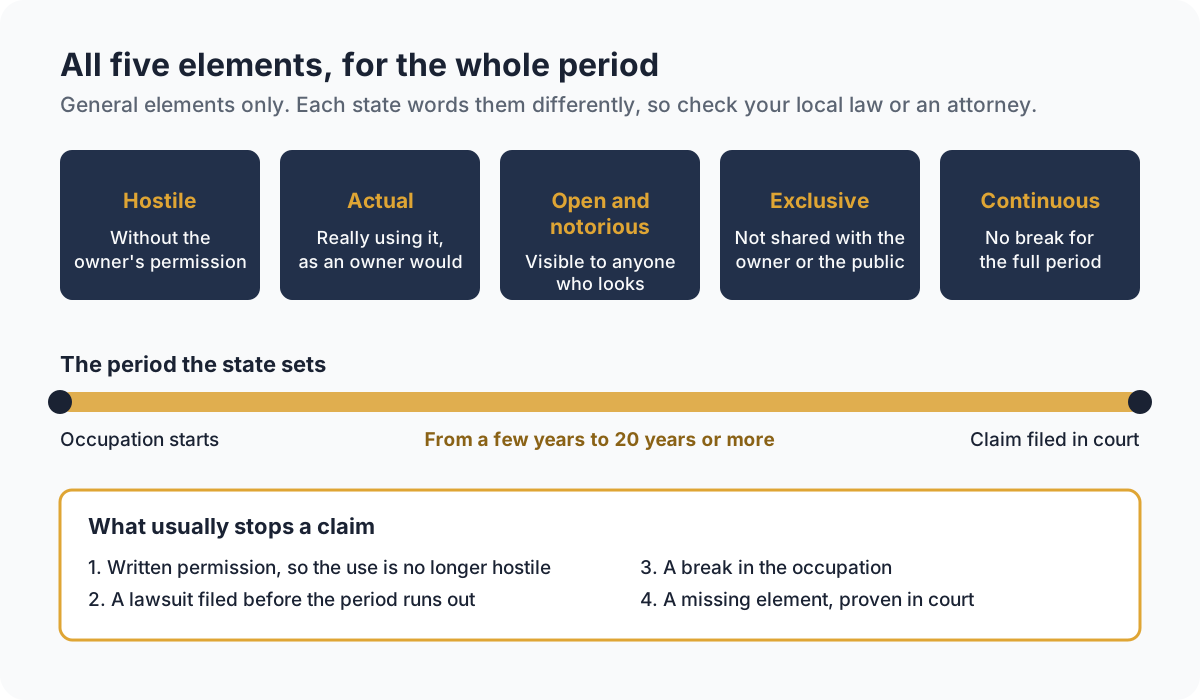
Some states add requirements of their own. The most common are paying the property taxes on the land during the period and having "color of title", which means a deed or other document that looks like it gives ownership but is flawed. In some states, either one can shorten the period.
How long does adverse possession take?
The period ranges from a few years in some states to 20 years or more in others. It is often shorter when the occupant has paid the property taxes or holds color of title, and it can be paused in some states while the owner is a minor or legally incapacitated.
In many states, people who occupy the land one after another can add their time together, which is called tacking, as long as one handed the land to the next, such as by a sale or an inheritance. A neighbor who bought the house next door may be able to count the years the previous owner kept the same fence in the same place.
When the period ends, the occupant usually still has to go to court, often in a quiet title action, to be recorded as the owner. The occupant generally carries the burden of proving every element, and many states require clear and convincing evidence.
Adverse possession vs squatting vs a prescriptive easement
These three ideas overlap, but each one is about something different:
| Adverse possession | Squatting | Prescriptive easement | |
|---|---|---|---|
| What it is | A claim to own the land | Living in a property without permission | A claim to keep using the land in one way |
| What the person can end up with | Title to the land | Nothing by itself; only a successful adverse possession claim gives title | A right to use, such as a path or a driveway |
| Does the use have to be exclusive | Yes | Not as such | No; the owner can keep using it too |
| How long it takes | The period the state sets | It starts with the first night | Usually a similar period, set by state law |
A squatter is someone living in a property without permission. Most squatters never come close to an adverse possession claim, because the owner finds them and acts long before the period ends. The real problem with squatters is usually the time and cost of getting them out.
A prescriptive easement is the right to keep using someone else's land in a particular way, such as crossing a yard to reach a garage. It needs open, continuous use without permission for the state's period, but the use does not have to be exclusive, and the owner keeps the land.
Can a tenant claim adverse possession?
Generally not while the lease runs. A tenant occupies the property with the owner's permission, so the use is not hostile. A tenant who stays after the lease ends is usually a holdover tenant, who is handled through notice and the eviction process. The question is closer when a former tenant or a tenant's guest stays on for years, openly claims the property as their own and the owner does nothing, so it pays to act when a lease ends and someone is still there.
Where adverse possession shows up for property owners
Most claims are about the edges and corners of a lot:
- Fences in the wrong place. A neighbor builds a fence a few feet onto your lot, and both households treat the fence as the line for years.
- Driveways, sheds and gardens that cross a property line.
- Vacant lots and rural land that the owner rarely visits, where a neighbor mows, farms or stores things.
- Long-vacant homes, where someone moves in and keeps the place up as if it were theirs.
A rental you own from a distance is exposed in the same ways, especially between tenants or when nobody has walked the boundary in years.
How to protect a property from adverse possession
Most of the protection comes from paying attention and putting permission in writing:
- Know where your lines are. A survey shows the true boundary. Compare it with fences, driveways and sheds on both sides, and keep it with the deed.
- Inspect the property on a schedule and keep dated notes and photos. A rental inspection checklist gives every visit the same record, outside as well as in.
- Deal with an encroachment early. Talk to the neighbor first. If the use can stay, put permission in writing, because permitted use is generally not hostile. If it has to end, ask for that in writing too.
- Put any permission in writing. A short signed agreement that lets a neighbor use a path or a strip of yard, and says you can end it, protects you better than letting the use go on unmentioned.
- Pay the property taxes on time and check that the tax bill covers the whole parcel, since some claims depend on the occupant paying them.
- Keep vacancies short. Empty months are when a property is easiest to occupy unnoticed. The vacancy rate calculator shows how much vacant time is costing you.
- Act within the period. If someone will not stop using your land, talk to a local attorney about a lawsuit before the state's period runs out. In many states a letter on its own may not stop the clock.
- Use only lawful steps. Removing a fence, tearing down a shed or changing locks on your own can lead to liability, even when the land is yours.
Frequently asked questions
What is adverse possession in simple terms?
It is a way someone who is not the owner can become the owner of land by using it openly, without permission and without a break for the period state law sets, and then proving it in court. Most claims are about fences, driveways and strips of yard.
Is adverse possession the same as squatters' rights?
Mostly. "Squatters' rights" is the everyday name for adverse possession. A squatter only gains title if they meet every element for the whole period and win in court, which is rare when the owner checks the property and acts.
How many years does adverse possession take?
It ranges from a few years in some states to 20 years or more in others. Some states shorten the period when the occupant has paid the property taxes or holds a flawed deed. Rules vary by state and city. Check your local law or an attorney.
Does paying property taxes give someone ownership?
Paying the taxes on its own does not make someone the owner. In some states, paying them is one of the requirements for an adverse possession claim, or it shortens the period. Keeping the taxes paid yourself removes that support from a claim.
How do I stop an adverse possession claim on my rental property?
Inspect the property, know where the boundary is, and deal with any use of your land early, either by ending it or by giving written permission. If someone will not stop, talk to a local attorney about filing in court before the state's period runs out.
Keep a record of every property
Adverse possession claims turn on who did what, and when. In KeyRing, each property keeps its own record: you can store documents such as the deed, a survey and inspection photos with the property they belong to, create a lease for each unit, and lease-expiry reminders go out by email and push automatically. See what KeyRing does or how plans are priced.
Free calculators and templates
- Vacancy rate calculatorThe share of the time units sat empty, and the rent it cost.
- Rental inspection checklistA room by room check of an occupied rental, with the repairs it turns up.
Browse all rental property calculators and free templates.